If you’ve ever been halfway through a cake recipe only to realize it calls for cake flour and all you have is all-purpose flour, you’ve probably wondered: Does cake flour actually make a difference, or is this one of those baking rules we’re overthinking?
The short answer is yes, cake flour can make a difference but not in every recipe.
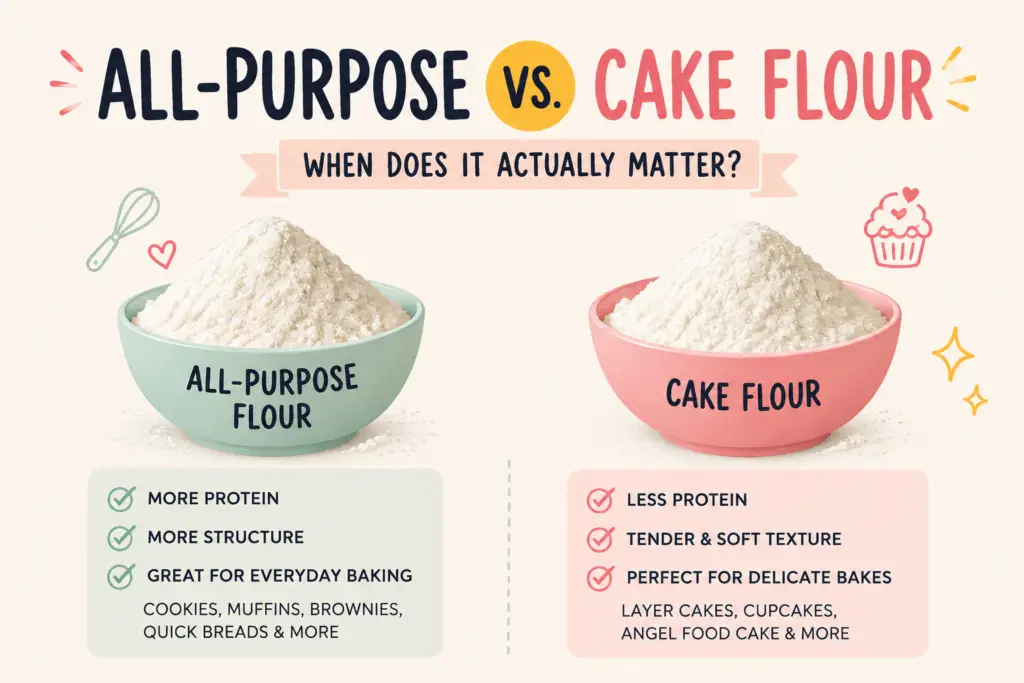
For soft vanilla cakes, angel food cake, cupcakes, and other desserts where you’re chasing an especially light, fine, tender crumb, cake flour can noticeably improve the texture. For cookies, brownies, muffins, quick breads, pancakes, and many everyday cakes, all-purpose flour is often exactly what you want.
The difference comes primarily down to protein and gluten development
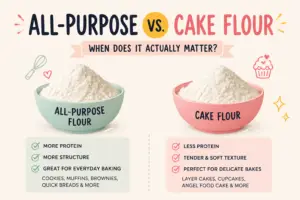
Cake flour generally contains less protein than all-purpose flour. Less protein means less potential gluten development, which can translate into a softer, more delicate baked good. All-purpose flour contains more protein and therefore provides a little more structure.
But, and this is important cake flour isn’t automatically “better” just because you’re baking a cake.
Some cakes actually need the extra structure of all-purpose flour.
So instead of keeping another specialty flour in your pantry simply because the word “cake” is printed on the box, let’s talk about all-purpose flour vs cake flour, when the difference really matters, when it doesn’t, and whether you can substitute one for the other.
All-Purpose Flour vs Cake Flour: The Quick Answer
If you don’t want the entire baking science lesson, here’s the easiest way to think about it:
Use cake flour when:
- You want an exceptionally soft and tender cake.
- The recipe specifically relies on cake flour for its texture.
- You’re making angel food cake or another very delicate cake.
- You want a fine, bakery-style crumb.
- You’re making light vanilla or white cupcakes where texture is especially noticeable.
Use all-purpose flour when:
- You’re making cookies.
- You’re baking brownies or blondies.
- You’re making muffins.
- You’re making banana bread or another quick bread.
- You’re baking a sturdier or denser cake.
- The recipe was developed specifically with all-purpose flour.
- You want one reliable flour for everyday baking.
And if a cake recipe calls for cake flour but you only have all-purpose flour?
Don’t panic.
You can often make the recipe successfully with all-purpose flour, although the finished cake may be slightly firmer or have a coarser crumb.
What Is All-Purpose Flour?
All-purpose flour is exactly what its name suggests: a versatile wheat flour designed to work across a wide range of recipes.
It sits somewhere between low-protein cake and pastry flours and higher-protein bread flour.
That middle ground is what makes it so useful.
Depending on the brand, protein percentages vary, but all-purpose flour generally has enough gluten-forming potential to provide structure while still being capable of producing tender baked goods.
For reference, King Arthur’s all-purpose flour contains 11.7% protein, while its cake flour contains 10%. Protein percentages can vary by brand, so don’t assume every bag of flour will have exactly the same numbers.
All-purpose flour works particularly well for:
- Bakery-Style Chocolate chip cookies
- Sugar cookies
- Brownies
- Blondies
- Muffins
- Quick breads
- Pancakes
- Scones
- Biscuits
- Waffles
- Pie crusts and cobblers
- Many cupcakes
- Many layer cakes
It’s the flour I would choose if I could keep only one flour in my kitchen.
What Is Cake Flour?
Cake flour is a softer, lower-protein wheat flour designed to encourage a delicate texture.
The important part isn’t necessarily that cake flour feels softer when you touch it.
It’s what happens once you combine the flour with liquid and begin mixing.
Wheat flour contains gluten-forming proteins. When flour becomes hydrated and the batter or dough is mixed, gluten can begin developing.
That gluten provides structure—which we absolutely need in baking—but too much development can make something that’s supposed to be tender feel tougher or chewier.
Cake flour’s lower protein content gives it less gluten-forming potential than all-purpose flour.
The result can be:
- Softer texture
- Finer crumb
- More delicate bite
- Less chewiness
- Tender cakes and cupcakes
This is why cake flour frequently appears in recipes where texture is one of the most important parts of the final result.
What’s the Difference Between All-Purpose Flour and Cake Flour?
The biggest difference is protein content and the resulting gluten-forming potential.
Think of flour protein as a spectrum.
Lower protein generally favors tenderness.
Higher protein generally favors strength and chew.
That’s why cake flour lives toward the tender end of the spectrum while bread flour lives toward the strong, chewy end. All-purpose flour falls conveniently in the middle.
Cake Flour
Lower protein
↓
Less gluten-forming potential
↓
Softer structure
↓
Finer, more delicate crumb
All-Purpose Flour
Moderate protein
↓
More gluten-forming potential
↓
Stronger structure
↓
Slightly firmer crumb
That sounds like a tiny technical difference.
In certain recipes, however, you can absolutely taste and see it.
Does Cake Flour Really Make Cake Softer?
Yes.
This is one situation where the name isn’t just clever marketing.
Because cake flour has less gluten-forming potential, it can help create the soft, fine crumb we associate with delicate bakery-style cakes.
King Arthur’s testing has similarly found that swapping all-purpose flour for cake flour can produce a slightly coarser crumb, while cake flour produces a finer and more even texture.
But there’s another important lesson here:
Flour isn’t the only thing controlling cake texture.
Your cake can still become tough even if you’re using cake flour.
Overmixing your batter encourages additional gluten development.
So if you’re aggressively beating the flour into your cake batter for several minutes, switching to cake flour isn’t going to magically fix everything.
For tender cake, flour choice and mixing technique work together.
When Does Cake Flour Actually Matter?
This is really the question I want to answer because I don’t think home bakers need another ingredient in the pantry unless it actually earns its spot.
There are recipes where I think cake flour is worth using.
And there are recipes where I wouldn’t make a special trip to the grocery store.
Cake Flour Matters Most When Texture Is the Star
Imagine biting into a really good vanilla layer cake.
There’s nowhere for the texture to hide.
You don’t have intense cocoa, chunks of chocolate, bananas, pumpkin, carrots, nuts, or other ingredients competing for your attention.
You’re noticing the crumb.
That’s when cake flour becomes more valuable.
I would be more inclined to use cake flour for:
- Vanilla layer cake
- White cake
- Angel food cake
- Chiffon-style cakes
- Funfetti Cake
- Delicate cupcakes
- Certain sponge cakes
- Very soft bakery-style cakes
The simpler the cake, the easier it is to notice subtle differences in texture.
When Cake Flour Doesn’t Matter As Much
Now let’s say we’re making a loaded chocolate cake covered with rich frosting.
Or banana muffins packed with mashed banana and chocolate chips.
Or fudgy brownies.
The difference between cake flour and all-purpose flour becomes far less important—and sometimes cake flour isn’t appropriate at all.
I usually reach for all-purpose flour for:
- Chocolate chip cookies
- Brownies
- Blondies
- Banana bread
- Pumpkin bread
- Zucchini bread
- Most muffins
- Pancakes
- Waffles
- Pie crust
- Cobbler
- Crumbles
- Crisps
- Hearty cakes
In many of these recipes, you actually want the additional structure all-purpose flour provides.
All-Purpose Flour vs Cake Flour for Cakes
Here’s where things get interesting.
You might assume:
Cake = cake flour.
Not necessarily.
Plenty of excellent cake recipes use all-purpose flour.
All-purpose flour provides more structure, which can be helpful when a cake contains substantial amounts of:
- Butter
- Oil
- Sugar
- Fruit
- Chocolate
- Frosting
- Fillings
A cake needs enough structure to rise, hold onto air and remain standing after it cools.
That’s why blindly replacing all-purpose flour with cake flour isn’t always a good idea.
Best rule:
Use whichever flour the cake recipe was developed with.
A good baking recipe is a formula. Changing the flour changes part of that formula.
All-Purpose Flour vs Cake Flour for Cupcakes
For light vanilla cupcakes, I love the texture cake flour can provide.
The crumb can feel especially soft and delicate.
But chocolate cupcakes, oil-based cupcakes and more substantial cupcake recipes often perform beautifully with all-purpose flour.
If you’re trying to create that ultra-soft bakery-style vanilla cupcake, cake flour may be worth experimenting with.
If you’re making quick everyday cupcakes for a birthday party?
All-purpose flour is completely reasonable.
All-Purpose Flour vs Cake Flour for Cookies
For most cookies, I recommend all-purpose flour unless the recipe specifically says otherwise.
Cookies need enough structure to hold together while controlling spread.
Cake flour can produce exceptionally tender cookies, and it can be intentionally used for that effect, but replacing all-purpose flour with cake flour isn’t always a harmless substitution.
You may end up with cookies that:
- Spread differently
- Feel overly delicate
- Have less chew
- Break more easily
- Lack the structure intended by the recipe
King Arthur similarly cautions that substituting cake flour 1:1 into recipes designed for all-purpose flour can result in baked goods that are too delicate or lack sufficient structure.
If you love a chewy chocolate chip cookie, stick with all-purpose flour.
All-Purpose Flour vs Cake Flour for Muffins
This is one where I generally choose all-purpose flour.
Muffins should be tender, but they still need enough structure to hold fruit, chocolate chips, streusel and other add-ins.
All-purpose flour provides a great balance.
You can use cake flour in certain muffin recipes for a softer, more cake-like texture, but I wouldn’t automatically make the swap.
Want a traditional blueberry muffin with a sturdy bakery-style top?
I’d use all-purpose.
Want an extremely soft, cupcake-like muffin?
Cake flour may be useful.
All-Purpose Flour vs Cake Flour for Brownies
Give me the all-purpose flour.
Brownies don’t need the airy, delicate crumb we’re chasing in vanilla cake.
Depending on your recipe, you’re probably looking for something:
Cake flour isn’t providing a major advantage there.
And because brownies often contain relatively little flour compared with cakes, I especially don’t think it’s worth overcomplicating things unless a particular recipe was formulated for cake flour.
All-Purpose Flour vs Cake Flour for Quick Breads
For banana bread, pumpkin bread, zucchini bread and similar quick breads, all-purpose flour wins for me.
These recipes contain lots of moisture and often have heavy ingredients or mix-ins.
They need structure.
All-purpose flour gives you enough strength without turning your quick bread into actual yeast bread.
Can You Substitute All-Purpose Flour for Cake Flour?
Usually, yes especially in a pinch.
If a recipe calls for cake flour and all you have is all-purpose flour, your cake isn’t automatically ruined.
The texture may simply be slightly different.
Expect a cake made with all-purpose flour to potentially have:
- A slightly firmer texture
- Slightly coarser crumb
- A little more structure
- Slightly less tenderness
For many casual cakes, the difference may be subtle.
For extremely delicate cakes, it’s more noticeable.
How to Make a Cake Flour Substitute
If you don’t have cake flour, you can mimic its lower protein level by combining all-purpose flour with cornstarch.
One tested method from King Arthur Baking combines:
3/4 cup + 2 tablespoons (105 grams) all-purpose flour
2 tablespoons (14 grams) cornstarch
Whisk them thoroughly together and use the mixture in place of cake flour by equal weight or volume. The cornstarch helps reduce the overall protein concentration of the mixture and encourages tenderness.
My Tip
Whisk the flour and cornstarch extremely well before adding them to your recipe.
You don’t want little pockets of cornstarch sitting throughout your cake batter.
And whenever possible, weigh your flour.
It’s one of the easiest ways to improve consistency in baking.
Can You Substitute Cake Flour for All-Purpose Flour?
This substitution requires more caution.
If a recipe calls for all-purpose flour, there’s probably a reason the recipe developer wanted that amount of structure.
Replacing it with cake flour could potentially make the finished product:
- Too delicate
- Too soft
- More prone to breaking
- Unable to support heavy ingredients
- Different in spread
- Different in rise
So while I don’t panic about substituting all-purpose flour into certain cake-flour recipes, I’m much more hesitant to automatically do the reverse.
Cake flour isn’t simply “better all-purpose flour.”
They’re different tools.
Does Cake Flour Make Cakes Rise Higher?
It can affect height, but flour isn’t the only factor determining rise.
Your final cake height also depends on:
- Baking powder or baking soda
- Eggs
- Mixing method
- How much air is incorporated
- Oven temperature
- Pan size
- Ingredient ratios
- Batter consistency
Cake flour can help create a lighter structure in recipes specifically formulated for it.
For example, King Arthur notes that its Traditional Angel Food Cake becomes taller and more tender when made with cake flour rather than all-purpose flour.
But don’t assume swapping cake flour into every recipe automatically creates a taller cake.
It doesn’t work that way.
Does Cake Flour Make Cake More Moist?
This is a common misconception.
Tender and moist aren’t exactly the same thing.
Cake flour primarily changes structure and tenderness.
Moisture is affected heavily by ingredients such as:
- Oil
- Butter
- Eggs
- Sour cream
- Greek yogurt
- Buttermilk
- Milk
- Sugar
- Fruit purées
A cake can be incredibly moist while using all-purpose flour.
And a cake made with cake flour can still be dry if it’s overbaked.
If your cake is dry, changing flour isn’t necessarily the first thing I would troubleshoot.
Why Protein Content Matters in Baking
This is the baking science that makes the whole comparison click.
Wheat flour contains proteins including glutenin and gliadin.
Once flour is hydrated and mixed, these proteins can contribute to gluten formation.
Gluten gives baked goods structure.
That’s fantastic when you’re making chewy bread.
It’s less desirable when you’re chasing a melt-in-your-mouth cake.
Higher-protein flour generally has greater gluten-forming potential, while lower-protein flour has less.
So:
Bread needs strength → higher protein can be helpful.
Cake needs tenderness → lower protein can be helpful.
Everyday baking needs versatility → all-purpose flour sits conveniently between them.
That’s really the entire flour aisle explained.
Why Overmixing Matters Just as Much
Here’s one of my biggest baking tips:
Don’t obsess over buying cake flour and then overmix your batter.
Once your dry ingredients go into your wet ingredients, you usually want to mix only until everything is incorporated unless your recipe specifically instructs otherwise.
More mixing can encourage more gluten development.
So even with lower-protein flour, aggressive mixing can work against the tender texture you’re trying to achieve.
When making cakes and muffins, I like to stop mixing as soon as I no longer see obvious streaks of dry flour.
Is Cake Flour Better for Bakery-Style Cakes?
For certain bakery-style cakes, absolutely.
If your idea of the perfect cake is:
- Light
- Tall
- Soft
- Fine-crumbed
- Delicate
- Tender
then cake flour can be a great tool.
But “bakery-style” doesn’t automatically mean cake flour.
Professional bakers formulate recipes around specific ingredients and protein percentages.
The better lesson for home bakers is:
Don’t choose flour based only on the name. Choose it based on the texture you’re trying to create.
Which Flour Makes Cake More Tender?
Cake flour generally wins.
Its lower protein level means less gluten-forming potential, which encourages a softer crumb.
But remember that tenderness also depends on:
- Fat
- Sugar
- Eggs
- Mixing technique
- Baking temperature
- Baking time
Flour is one piece of the puzzle—not the entire puzzle.
Which Flour Gives Cake More Structure?
All-purpose flour.
Its higher protein content gives it more gluten-forming potential than cake flour.
That can be useful for:
- Heavier cakes
- Fruit-filled cakes
- Muffins
- Quick breads
- Cookies
- Baked goods with substantial mix-ins
Sometimes structure is exactly what you need.
Does the Brand of Flour Matter?
It can.
Protein levels aren’t necessarily identical across every brand of flour.
That’s why one brand of all-purpose flour may behave a little differently from another.
If you’ve made the exact same recipe dozens of times and suddenly the texture changes after switching flour brands, you’re not necessarily imagining it.
Flour protein level and milling characteristics can affect how much liquid flour absorbs and how the finished baked good behaves.
Consistency is one reason I like finding a flour that works well in my recipes and sticking with it.
All-Purpose Flour vs Cake Flour Comparison
| All-Purpose Flour | Cake Flour | |
|---|---|---|
| Protein | Moderate | Lower |
| Gluten potential | More | Less |
| Texture | Stronger | More delicate |
| Crumb | Slightly coarser | Finer |
| Best for everyday baking | Yes | Sometimes |
| Cookies | Excellent | Recipe dependent |
| Brownies | Excellent | Usually unnecessary |
| Muffins | Excellent | Softer/cakier result |
| Quick breads | Excellent | Usually unnecessary |
| Vanilla cake | Good | Excellent for extra tenderness |
| Angel food cake | Can work | Often preferred |
| Cupcakes | Good | Excellent for delicate cupcakes |
| Bread | Can work | No |
| Pantry staple | Absolutely | Optional |
The Easiest Way to Remember the Difference
Here’s my little baking cheat sheet:
Cake flour = tenderness.
All-purpose flour = versatility + structure.
If I’m making a delicate vanilla layer cake and the recipe calls for cake flour, I’m using cake flour.
If I’m making chocolate chip cookies, banana bread, brownies or blueberry muffins, I’m reaching for all-purpose flour.
And if I’m making an everyday cake recipe that specifically calls for all-purpose flour?
I’m not changing it just because there’s a box of cake flour sitting in my pantry.
Common Flour Mistakes to Avoid
1. Assuming Cake Flour Is Better for Every Cake
It isn’t.
The best flour is the flour your recipe was formulated around.
2. Substituting Cake Flour Into Every Recipe
Lower protein means less structure.
That’s not desirable for every baked good.
3. Overmixing Cake Batter
Cake flour won’t completely save a batter that’s been aggressively overmixed.
4. Packing Flour Into the Measuring Cup
Too much flour can make cakes and muffins dry and dense.
For the most accurate baking, use a kitchen scale.
5. Changing Flour and Other Ingredients at the Same Time
If you’re testing a recipe, change one variable at a time.
Otherwise, you’ll have no idea which substitution changed the result.
6. Assuming Tender Means Moist
They’re related sensory experiences, but they’re not identical.
Cake flour primarily helps with tenderness and crumb structure.
7. Ignoring the Recipe
If a recipe developer specifically tested a recipe with cake flour, there’s usually a reason.
My Final Verdict: All-Purpose Flour vs Cake Flour
So, does cake flour actually matter?
Sometimes, quite a bit.
But not nearly as often as the name on the box might make you think.
For delicate cakes where you want an exceptionally soft, fine crumb, cake flour can absolutely be worth using.
For everyday baking, all-purpose flour remains the workhorse.
It’s versatile, reliable and strong enough for cookies, brownies, muffins and quick breads while still being perfectly capable of producing excellent cakes.
If I had room for only one flour in my pantry, I’d choose all-purpose flour.
If I were trying to perfect a light vanilla layer cake or incredibly tender cupcakes?
I’d make room for the cake flour.
That’s the difference.
Cake flour is a specialist. All-purpose flour is the multitasker.
And knowing when you actually need the specialist is what makes you a better baker.
More Baking Guides to Try
If you love understanding the why behind baking instead of simply following a recipe, keep exploring ingredient comparisons and baking guides like: