If you have ever started baking only to realize your recipe uses grams instead of cups, you are not alone. Baking measurements can get confusing fast, especially when you are switching between US customary measurements and metric measurements.
This baking measurement conversion chart covers cups, tablespoons, teaspoons, ounces, milliliters, and grams. You will also find ingredient-specific weight conversions for flour, sugar, butter, cocoa powder, and other common baking staples.
Bookmark this page, print the charts, or keep it open while you bake. It can save you from trying to do math with flour-covered hands.
Quick Baking Measurement Conversion Chart
Use this chart for basic volume conversions. These measurements work for both dry and liquid ingredients when you are converting between cups, tablespoons, and teaspoons.
| Measurement | Tablespoons | Teaspoons | Fluid Ounces | Milliliters |
|---|---|---|---|---|
| 1 cup | 16 tbsp | 48 tsp | 8 fl oz | 240 ml |
| 3/4 cup | 12 tbsp | 36 tsp | 6 fl oz | 180 ml |
| 2/3 cup | 10 tbsp + 2 tsp | 32 tsp | 5 1/3 fl oz | 160 ml |
| 1/2 cup | 8 tbsp | 24 tsp | 4 fl oz | 120 ml |
| 1/3 cup | 5 tbsp + 1 tsp | 16 tsp | 2 2/3 fl oz | 80 ml |
| 1/4 cup | 4 tbsp | 12 tsp | 2 fl oz | 60 ml |
| 1/8 cup | 2 tbsp | 6 tsp | 1 fl oz | 30 ml |
| 1 tablespoon | 1 tbsp | 3 tsp | 1/2 fl oz | 15 ml |
| 1 teaspoon | 1/3 tbsp | 1 tsp | About 1/6 fl oz | 5 ml |
Cups to Tablespoons Conversion Chart
Knowing how many tablespoons are in a cup is helpful when your measuring cups are dirty, missing, or already being used for another ingredient.
| Cups | Tablespoons |
|---|---|
| 1 cup | 16 tablespoons |
| 7/8 cup | 14 tablespoons |
| 3/4 cup | 12 tablespoons |
| 2/3 cup | 10 tablespoons + 2 teaspoons |
| 1/2 cup | 8 tablespoons |
| 1/3 cup | 5 tablespoons + 1 teaspoon |
| 1/4 cup | 4 tablespoons |
| 1/8 cup | 2 tablespoons |
The one conversion I use most often is 1/4 cup equals 4 tablespoons. It comes in handy when measuring butter, oil, nut butter, and other ingredients that are easier to scoop with a tablespoon.
Tablespoons to Teaspoons Conversion Chart
There are 3 teaspoons in 1 tablespoon.
| Tablespoons | Teaspoons |
|---|---|
| 1 tablespoon | 3 teaspoons |
| 2 tablespoons | 6 teaspoons |
| 3 tablespoons | 9 teaspoons |
| 4 tablespoons | 12 teaspoons |
| 5 tablespoons | 15 teaspoons |
| 6 tablespoons | 18 teaspoons |
| 8 tablespoons | 24 teaspoons |
| 12 tablespoons | 36 teaspoons |
| 16 tablespoons | 48 teaspoons |
Teaspoon Conversion Chart
Recipes sometimes call for measurements that are smaller than a teaspoon. This is common with salt, baking soda, baking powder, spices, and extracts.
| Measurement | Equivalent |
|---|---|
| 1 tablespoon | 3 teaspoons |
| 1 teaspoon | 2 half-teaspoons |
| 1 teaspoon | 4 quarter-teaspoons |
| 3/4 teaspoon | 1/2 teaspoon + 1/4 teaspoon |
| 1/2 teaspoon | 2 quarter-teaspoons |
| 1/4 teaspoon | 2 eighth-teaspoons |
| 1/8 teaspoon | Half of 1/4 teaspoon |
| A pinch | About 1/16 teaspoon |
A pinch is not always an exact measurement. When a recipe calls for a pinch of salt, use the small amount you can comfortably hold between your thumb and index finger.
Cups to Fluid Ounces Conversion Chart
Fluid ounces measure volume. Regular ounces measure weight. They are not interchangeable, even though both are called ounces.
| Cups | Fluid Ounces |
|---|---|
| 1 cup | 8 fluid ounces |
| 3/4 cup | 6 fluid ounces |
| 2/3 cup | 5 1/3 fluid ounces |
| 1/2 cup | 4 fluid ounces |
| 1/3 cup | 2 2/3 fluid ounces |
| 1/4 cup | 2 fluid ounces |
| 1/8 cup | 1 fluid ounce |
For example, 8 fluid ounces of milk equals 1 cup because milk is being measured by volume. Eight ounces of flour is a weight measurement and equals much more than 1 cup.
US Cups to Milliliters
A US cup is commonly rounded to 240 milliliters in American recipes. A metric cup is 250 milliliters, so check where your recipe was written before converting it.
| US Measurement | Milliliters |
|---|---|
| 1 cup | 240 ml |
| 3/4 cup | 180 ml |
| 2/3 cup | 160 ml |
| 1/2 cup | 120 ml |
| 1/3 cup | 80 ml |
| 1/4 cup | 60 ml |
| 1 tablespoon | 15 ml |
| 1 teaspoon | 5 ml |
| 1/2 teaspoon | 2.5 ml |
| 1/4 teaspoon | 1.25 ml |
These are rounded kitchen conversions. Slight differences of a few milliliters usually will not affect most home-baking recipes.
How Many Grams Are in One Cup?
There is no single answer because cups measure volume while grams measure weight. One cup of flour does not weigh the same as one cup of sugar, butter, or chocolate chips.
For example:
- 1 cup of all-purpose flour weighs about 120 grams
- 1 cup of granulated sugar weighs about 200 grams
- 1 cup of packed brown sugar weighs about 213 grams
- 1 cup of butter weighs about 227 grams
This is why ingredient-specific charts are needed when converting cups to grams.
Cups to Grams Conversion Chart for Common Baking Ingredients
The weights below are practical averages. Brands, ingredient texture, measuring technique, and how firmly an ingredient is packed can cause small changes.
| Ingredient | 1 Cup | 3/4 Cup | 1/2 Cup | 1/3 Cup | 1/4 Cup |
|---|---|---|---|---|---|
| All-purpose flour | 120 g | 90 g | 60 g | 40 g | 30 g |
| Bread flour | 120 g | 90 g | 60 g | 40 g | 30 g |
| Cake flour | 112 g | 84 g | 56 g | 37 g | 28 g |
| Whole wheat flour | 120 g | 90 g | 60 g | 40 g | 30 g |
| Granulated sugar | 200 g | 150 g | 100 g | 67 g | 50 g |
| Light brown sugar, packed | 213 g | 160 g | 107 g | 71 g | 53 g |
| Powdered sugar | 120 g | 90 g | 60 g | 40 g | 30 g |
| Butter | 227 g | 170 g | 113 g | 76 g | 57 g |
| Cocoa powder | 85 g | 64 g | 43 g | 28 g | 21 g |
| Chocolate chips | 170 g | 128 g | 85 g | 57 g | 43 g |
| Rolled oats | 90 g | 68 g | 45 g | 30 g | 23 g |
| Honey | 340 g | 255 g | 170 g | 113 g | 85 g |
| Maple syrup | 315 g | 236 g | 158 g | 105 g | 79 g |
| Peanut butter | 256 g | 192 g | 128 g | 85 g | 64 g |
| Sour cream | 240 g | 180 g | 120 g | 80 g | 60 g |
| Greek yogurt | 245 g | 184 g | 123 g | 82 g | 61 g |
| Milk | 240 g | 180 g | 120 g | 80 g | 60 g |
| Heavy cream | 240 g | 180 g | 120 g | 80 g | 60 g |
| Vegetable oil | 218 g | 164 g | 109 g | 73 g | 55 g |
| Shredded coconut | 85 g | 64 g | 43 g | 28 g | 21 g |
| Chopped nuts | 115 g | 86 g | 58 g | 38 g | 29 g |
Flour Measurement Conversion Chart
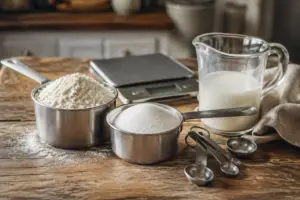
Flour is one of the easiest baking ingredients to measure incorrectly. Scooping it directly from the bag can pack extra flour into the cup, leaving you with dry cakes, thick cookie dough, or dense bread.
| Flour Measurement | Approximate Weight |
|---|---|
| 1 cup all-purpose flour | 120 g |
| 3/4 cup all-purpose flour | 90 g |
| 2/3 cup all-purpose flour | 80 g |
| 1/2 cup all-purpose flour | 60 g |
| 1/3 cup all-purpose flour | 40 g |
| 1/4 cup all-purpose flour | 30 g |
| 1 tablespoon all-purpose flour | 8 g |
How to measure flour without a scale
Fluff the flour inside its container with a spoon. Spoon it into a dry measuring cup without pressing it down. Once the cup is full, sweep a straight edge across the top.
Do not shake the cup or tap it against the counter. Both actions can settle the flour and add more than the recipe needs.
Sugar Measurement Conversion Chart
Different sugars have different weights. Granulated sugar settles closely together, powdered sugar contains more air, and brown sugar is normally packed into the measuring cup.
| Sugar | 1 Cup | 1/2 Cup | 1/4 Cup |
|---|---|---|---|
| Granulated sugar | 200 g | 100 g | 50 g |
| Packed light brown sugar | 213 g | 107 g | 53 g |
| Packed dark brown sugar | 213 g | 107 g | 53 g |
| Powdered sugar | 120 g | 60 g | 30 g |
| Coarse sugar | 200 g | 100 g | 50 g |
Unless the recipe says otherwise, brown sugar should be pressed firmly into the measuring cup. It should hold the shape of the cup when turned out.
Powdered sugar may need to be sifted if the recipe specifically calls for sifted powdered sugar. Read the order of the words carefully. “One cup powdered sugar, sifted” means measure first and sift afterward. “One cup sifted powdered sugar” means sift first and then measure.
Butter Measurement Conversion Chart
Butter packaging in the United States usually includes tablespoon markings, which makes it easy to divide a stick without using a measuring cup.
| Butter | Cups | Tablespoons | Grams | Ounces |
|---|---|---|---|---|
| 4 sticks | 2 cups | 32 tbsp | 454 g | 16 oz |
| 2 sticks | 1 cup | 16 tbsp | 227 g | 8 oz |
| 1 1/2 sticks | 3/4 cup | 12 tbsp | 170 g | 6 oz |
| 1 stick | 1/2 cup | 8 tbsp | 113 g | 4 oz |
| 1/2 stick | 1/4 cup | 4 tbsp | 57 g | 2 oz |
| 1 tablespoon | 1/16 cup | 1 tbsp | 14 g | 1/2 oz |
Salted and unsalted butter weigh the same, so the chart works for both.
Baking Pan Size Conversions
Changing the pan size can affect baking time, browning, thickness, and texture. Try to choose a replacement pan with a similar capacity.
| Original Pan | Approximate Substitute |
|---|---|
| 8-inch square pan | 9-inch round pan |
| 9-inch square pan | 10-inch round pan |
| 9-inch round pan | 8-inch square pan |
| Two 8-inch round pans | One 9-by-13-inch pan |
| Two 9-inch round pans | One 9-by-13-inch pan |
| 9-by-5-inch loaf pan | Three mini loaf pans |
| 10-inch Bundt pan | Two 9-by-5-inch loaf pans |
| 12 standard muffins | About 36 mini muffins |
| 12 standard muffins | About 6 jumbo muffins |
Watch the bake rather than relying only on the original time. A thinner layer of batter will usually bake faster, while a deeper layer may need more time.
US Measurements vs. Metric Measurements
US recipes usually measure ingredients by volume with cups, tablespoons, and teaspoons. Many recipes written outside the United States rely on grams and milliliters.
Weight measurements are often more consistent because they do not depend on how firmly an ingredient is packed into a cup. A kitchen scale also lets you measure directly into the mixing bowl, which means fewer dishes.
Volume measurements can still work well when the recipe has been tested that way. The best choice is usually to follow the measurement system used by the recipe writer instead of converting every ingredient.
Dry Measuring Cups vs. Liquid Measuring Cups
Dry and liquid measuring cups hold the same volume, but their shapes are designed for different jobs.
Dry measuring cups are filled to the top and leveled. They work best for flour, sugar, oats, cocoa powder, chocolate chips, and similar ingredients.
Liquid measuring cups have a pouring spout and measurement lines below the rim. They work best for milk, cream, oil, water, honey, and other liquids.
To measure a liquid, set the cup on a flat surface and look at it from eye level. Reading the line while holding the cup in the air can lead to an inaccurate measurement.
Weight Ounces vs. Fluid Ounces
One of the most common baking conversion mistakes is treating ounces and fluid ounces as if they mean the same thing.
- Ounces measure weight.
- Fluid ounces measure volume.
- Grams measure weight.
- Milliliters measure volume.
A recipe calling for 8 ounces of chocolate needs chocolate weighed on a scale. A recipe calling for 8 fluid ounces of milk needs 1 cup of milk.
The numbers may occasionally match for water and similar liquids, but that does not make the units interchangeable for every ingredient.
How to Use a Kitchen Scale for Baking
A kitchen scale is simple once you use it a few times.
- Place your empty mixing bowl on the scale.
- Press the tare or zero button.
- Add the first ingredient until you reach the listed weight.
- Press tare again before adding the next ingredient.
- Continue until all ingredients have been measured.
Check whether the scale is set to grams, ounces, or milliliters before you begin. For most baking recipes, grams will give you the easiest and most precise numbers.
Can You Convert Any Baking Recipe From Cups to Grams?
You can convert most recipes, but a general online calculator may not give you the right answer for every ingredient. A cup of every ingredient does not weigh the same.
It is safer to use a trusted ingredient-specific weight chart. If the original recipe includes both cups and grams, use the measurements supplied by the recipe writer. Those gram measurements should match the way the recipe was tested.
Small differences are rarely a problem with mix-ins such as chocolate chips or chopped nuts. They can matter much more with flour, leavening agents, and liquids.
Tips for Accurate Baking Measurements
- Read the whole recipe first. Check whether the recipe uses volume, weight, or a combination of both. Look for directions such as sifted, packed, softened, melted, divided, or room temperature.
- Do not pack flour. Use the spoon-and-level method when a scale is not available. Too much flour is a common reason cookies do not spread or cakes turn out dry.
- Pack brown sugar unless told otherwise. Press brown sugar into the measuring cup and level the top. It should hold its shape after it is removed.
- Measure liquids at eye level. Place the liquid measuring cup on the counter. Bend down until the measurement mark is level with your eyes.
- Use measuring spoons for small amounts. Regular eating spoons are not standard sizes. Use actual measuring spoons for vanilla, salt, baking powder, baking soda, and spices.
- Level dry ingredients. Run the flat edge of a knife across the top of the measuring cup or spoon. Do not level liquids or packed brown sugar.
- Keep the measuring system consistent. If a recipe provides both cups and grams, choose one set of measurements. Switching back and forth can introduce small differences.
Common Baking Measurement Mistakes
Even a good recipe can go wrong when the measurements change.
- Confusing fluid ounces with weight ounces
- Assuming every cup weighs the same in grams
- Scooping flour directly from the container
- Forgetting to pack brown sugar
- Measuring liquids in dry cups
- Using household spoons instead of measuring spoons
- Converting a US cup as 250 milliliters instead of 240 milliliters
- Forgetting to zero the scale after adding the bowl
- Measuring butter before checking the wrapper markings
- Doubling most of a recipe but forgetting the baking powder, salt, or vanilla
How to Double or Halve Baking Measurements
Doubling a recipe is usually simple, but halving measurements such as 3/4 teaspoon can require a little math.
| Original Amount | Half | Double |
|---|---|---|
| 1 cup | 1/2 cup | 2 cups |
| 3/4 cup | 6 tablespoons | 1 1/2 cups |
| 2/3 cup | 1/3 cup | 1 1/3 cups |
| 1/2 cup | 1/4 cup | 1 cup |
| 1/3 cup | 2 tablespoons + 2 teaspoons | 2/3 cup |
| 1/4 cup | 2 tablespoons | 1/2 cup |
| 1 tablespoon | 1 1/2 teaspoons | 2 tablespoons |
| 1 teaspoon | 1/2 teaspoon | 2 teaspoons |
| 3/4 teaspoon | 3/8 teaspoon | 1 1/2 teaspoons |
| 1/2 teaspoon | 1/4 teaspoon | 1 teaspoon |
| 1/4 teaspoon | 1/8 teaspoon | 1/2 teaspoon |
To measure 3/8 teaspoon, use 1/4 teaspoon plus 1/8 teaspoon.
Eggs can be harder to halve. Crack the egg into a small bowl, beat it until combined, and measure half by weight or volume. One large egg without the shell weighs about 50 grams, so half is about 25 grams.
Does Measurement Accuracy Really Matter in Baking?
Baking depends on a balance of flour, fat, sugar, moisture, eggs, and leavening. A small change in one ingredient can change how the batter spreads, rises, browns, or sets.
That does not mean you need laboratory-level precision. It simply means measuring flour carefully, using the right tools, and following the recipe’s method will give you a better chance of getting the intended result.
Savory cooking often leaves more room for adjustments. Baking is usually less forgiving because the ingredients create chemical and structural changes in the oven.
Best Measuring Tools for Home Bakers
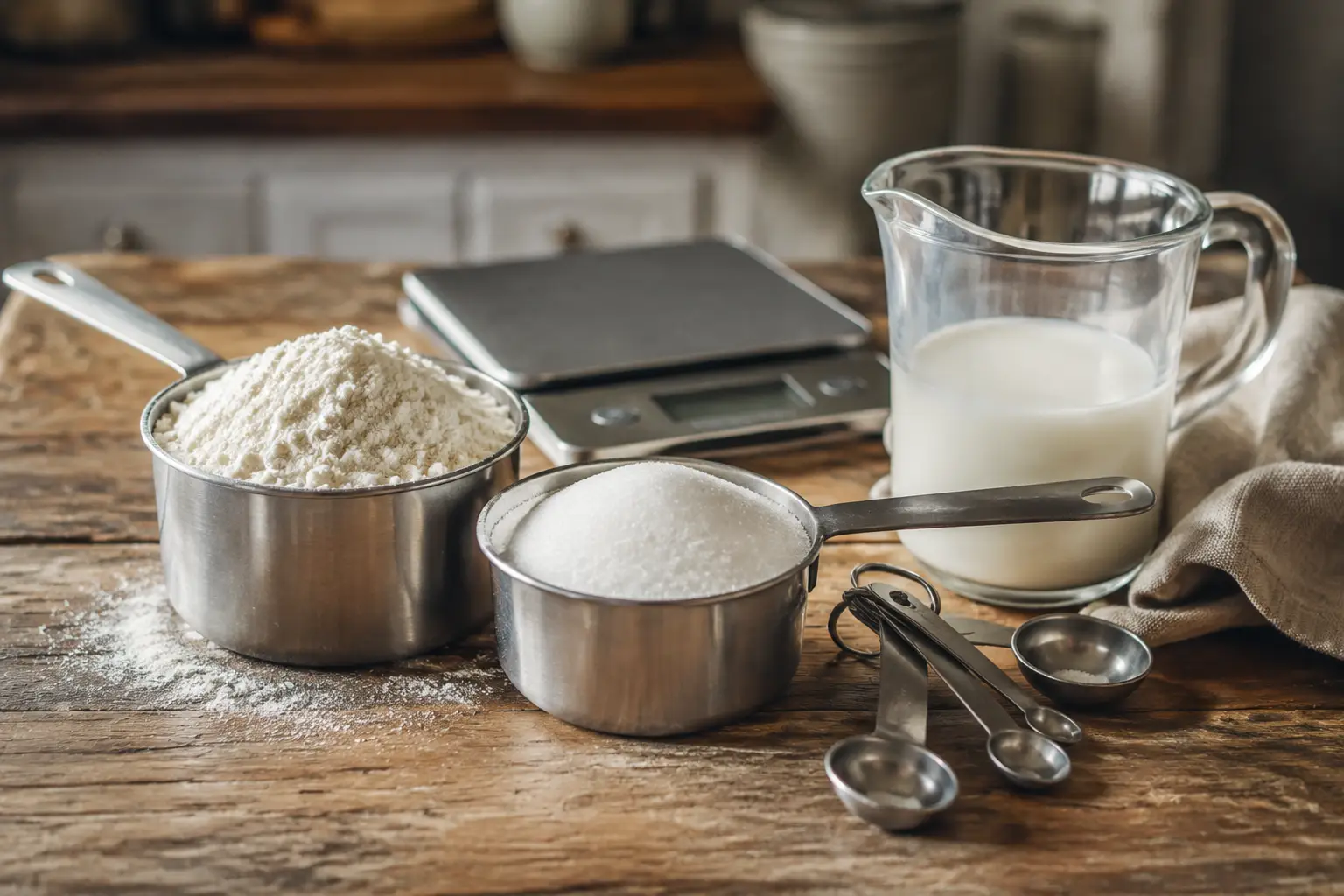
You do not need a drawer full of gadgets. A basic set should include:
- Nested dry measuring cups
- Liquid measuring cup with clear markings
- Measuring spoons
- Digital kitchen scale
- Straight-edged knife or leveling tool
- Small bowl for weighing ingredients
Choose measuring cups and spoons with markings that are easy to read. A scale with a tare button and measurements in both grams and ounces is helpful for recipes from different countries.
Save This Baking Conversion Chart
Measurement conversions become much easier once you remember a few basics:
- 1 cup equals 16 tablespoons
- 1 tablespoon equals 3 teaspoons
- 1 cup equals 8 fluid ounces
- 1 US cup equals about 240 milliliters
- Cups cannot be converted to grams without knowing the ingredient
- 1 cup of all-purpose flour weighs about 120 grams
- 1 cup of granulated sugar weighs about 200 grams
- 1 cup of butter weighs about 227 grams
Keep this page nearby when you are baking cookies, cakes, muffins, brownies, quick breads, or homemade bread. It is much easier to check a chart than guess and hope for the best.
More Baking Guides to Try
- Butter Measurement Guide: Sticks, Cups, Tablespoons, and Grams Converted
- Complete Egg Substitute Guide for Baking
- All-Purpose Flour vs. Cake Flour
- Brown Sugar vs. White Sugar in Baking
- Butter vs. Oil in Baking
- Baking Tips for Complete Beginners
- Buttermilk Substitute: 5 Easy Ways to Make It
- What Does Cottage Cheese Do in Baking?
- Salt and Chocolate: Why Dessert Recipes Need Salt