If you have ever stood in your kitchen holding a stick of butter in one hand and a bottle of oil in the other wondering, “Which one actually makes a better cake or muffin?” you are definitely not alone.
Butter vs oil in baking is one of those questions that sounds simple until you start thinking about what you actually want from your baked goods. Do you want a buttery, bakery-style flavor? A super-moist muffin that stays soft the next morning? A fluffy vanilla birthday cake? Or a rich chocolate cake that somehow tastes even better on day two?
The answer is that butter and oil do completely different things in baking.
Butter generally wins when flavor, structure, and a lighter creamed texture are the priority. Oil usually wins when you want maximum moisture, tenderness, and a cake or muffin that stays soft longer. And sometimes my personal favorite solution, the best answer is using both.
If you have ever wondered whether you can substitute oil for butter in cake, whether muffins are better with butter or oil, or why some bakery cakes stay incredibly moist for days, this guide breaks it all down.
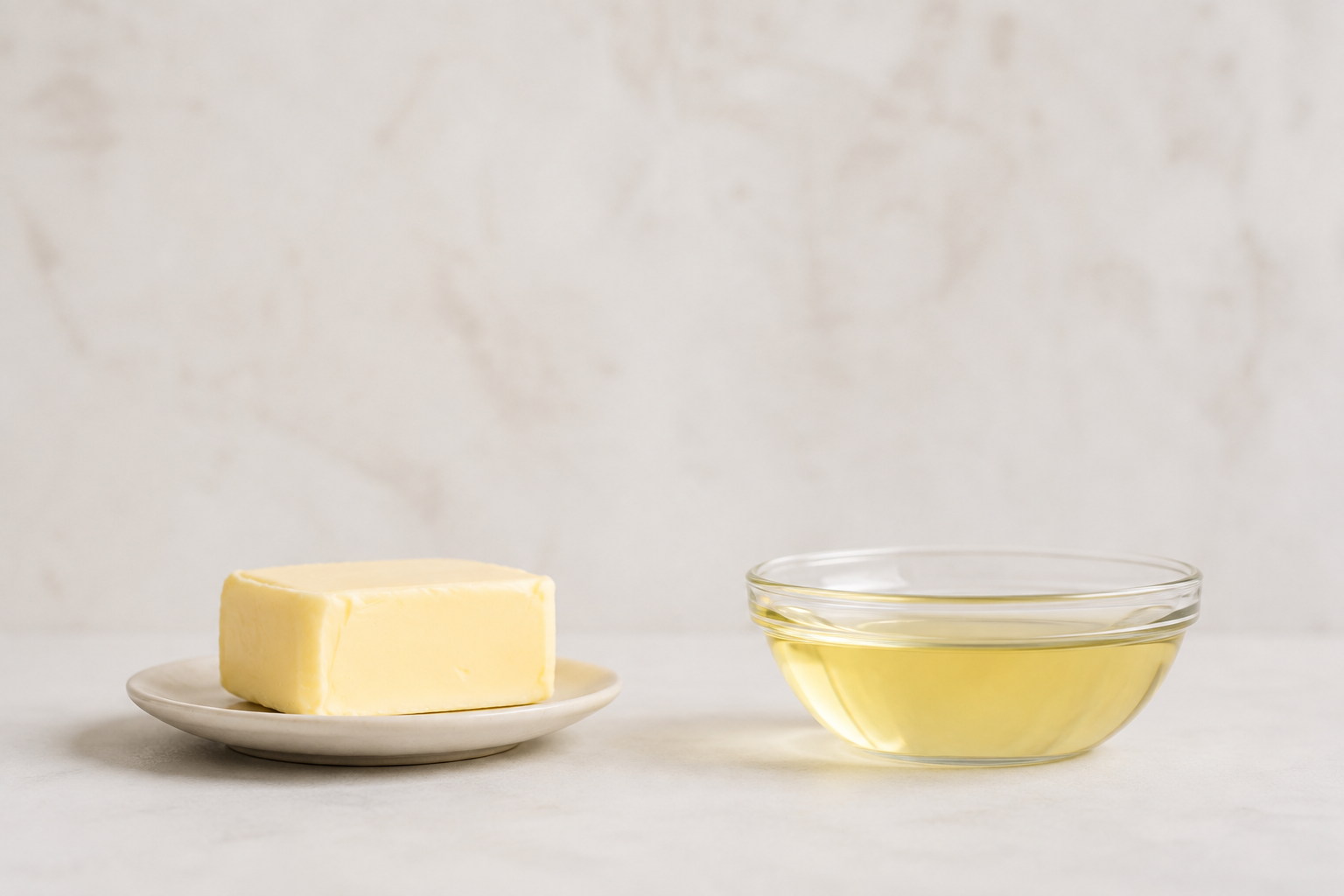
Butter vs Oil in Baking: The Quick Answer
Here is the simplest way I explain it:
Butter = better buttery flavor and structure.
Oil = better moisture and longer-lasting softness.
Butter + oil = often the best of both worlds.
Butter contains both fat and water, while cooking oil is essentially all fat. Typical American butter is at least 80% butterfat and contains roughly 18% water. That difference affects everything from crumb and moisture to how your cake tastes after sitting overnight.
King Arthur Baking has even reformulated some butter-based cakes by replacing approximately 25% to 50% of the butter with vegetable oil to help create a softer cake that doesn’t dry out as quickly.
So there really isn’t one universal winner.
The better fat depends on what you’re baking and the texture you’re trying to create.
Butter vs Oil in Baking Comparison
| Baking Quality | Butter | Oil |
|---|---|---|
| Flavor | ⭐⭐⭐⭐⭐ | ⭐⭐⭐ |
| Moisture | ⭐⭐⭐⭐ | ⭐⭐⭐⭐⭐ |
| Softness over several days | ⭐⭐⭐ | ⭐⭐⭐⭐⭐ |
| Light, creamed texture | ⭐⭐⭐⭐⭐ | ⭐⭐⭐ |
| Tender crumb | ⭐⭐⭐⭐ | ⭐⭐⭐⭐⭐ |
| Ease of mixing | ⭐⭐⭐ | ⭐⭐⭐⭐⭐ |
| Rich bakery flavor | ⭐⭐⭐⭐⭐ | ⭐⭐⭐ |
| Best for chocolate cake | Great | Excellent |
| Best for vanilla cake | Excellent | Great |
| Best for muffins | Excellent | Excellent |
| Best overall solution | Butter + oil | Butter + oil |
Why Fat Matters So Much in Baking
Before deciding between butter and oil, it helps to understand why recipes need fat in the first place.
Fat isn’t simply there to make cake taste good.
Butter and oil contribute to:
- tenderness
- moisture
- mouthfeel
- flavor
- crumb structure
- freshness
- browning
- how quickly baked goods become stale
Fat coats flour proteins and helps limit gluten development, contributing to a softer, more tender baked good.
That is one reason cakes and muffins with sufficient fat usually feel soft rather than chewy like bread.
Both butter and oil accomplish this, but they don’t behave exactly the same way.
What Does Butter Do in Baking?
Butter is one of my favorite baking ingredients because its biggest advantage is obvious the second something comes out of the oven:
Flavor.
Nothing quite replaces the flavor and aroma of real butter in a vanilla cake, pound cake, muffin, cookie, or crumb topping.
But flavor isn’t butter’s only advantage.
Butter Can Help Create a Lighter Cake
Many traditional cake recipes begin by creaming softened butter and sugar together.
This isn’t just mixing the ingredients.
Creaming incorporates tiny pockets of air into the fat. Those pockets can expand during baking and contribute to a lighter cake structure.
King Arthur describes traditional creamed butter cakes as having a light texture with a somewhat open structure that is firm and springy.
That makes butter especially valuable in cakes where structure and fluffiness matter.
Think:
- vanilla layer cake
- yellow cake
- pound cake
- cupcakes
- butter cake
- coffee cake
Butter Adds Incredible Flavor
This is where butter really shines.
Butter contains milk solids that contribute rich dairy flavor and aroma that neutral vegetable oils simply don’t provide.
When you’re making a relatively simple recipe—like vanilla cupcakes or a classic yellow cake—that buttery flavor can be a major part of what makes the dessert taste homemade.
What Does Oil Do in Baking?
Oil’s superpower is different.
Oil makes incredibly moist, tender baked goods.
Unlike butter, oil remains liquid at room temperature.
That means an oil-based cake can continue feeling soft even after it has completely cooled.
King Arthur notes that oil-based cakes can stay supple longer because oil remains liquid at room temperature, whereas butter becomes solid.
This is one reason oil works beautifully in recipes like:
- chocolate cake
- carrot cake
- zucchini cake
- banana muffins
- blueberry muffins
- pumpkin muffins
- spice cake
- chocolate muffins
- quick breads
These recipes benefit tremendously from a soft, moist crumb.
Why Does Oil Make Cake More Moist?
This is one of the most searched questions surrounding butter vs oil in baking, and there is actual baking science behind the answer.
Butter isn’t 100% fat.
Standard American butter generally contains at least 80% fat along with water and milk solids.
Oil, meanwhile, is essentially pure fat.
During baking, some of the water contained in butter evaporates. Oil doesn’t have that same water component to lose.
King Arthur explains that replacing some butter with oil leaves more fat in the finished cake, helping maintain tenderness. Oil also coats flour very effectively, which can help protect against toughness.
The result?
A cake that often feels:
softer + moister + more tender
And it usually stays that way longer.
Does Butter Make Cake Dry?
Not automatically.
There are plenty of wonderfully moist butter cakes.
But an all-butter cake can become firm or seem drier sooner than an oil-based cake, especially when refrigerated.
Butter solidifies when cold.
Oil doesn’t.
That distinction becomes really obvious when you pull two cakes from the refrigerator. An oil-based cake can still feel relatively tender while a butter-heavy cake may feel noticeably firmer.
Once the butter cake returns to room temperature, it will soften again.
King Arthur specifically recommends serving butter cakes at room temperature because they are softer and more flavorful than when served directly from the refrigerator.
Butter vs Oil in Muffins: Which Is Better?
Now let’s get to one of my favorite baking debates:
Are muffins better with butter or oil?
My answer?
It depends on the muffin.
Use Butter When You Want Bakery-Style Flavor
Butter works beautifully in muffins where you want a pronounced buttery flavor.
I especially like butter for:
- vanilla muffins
- cinnamon muffins
- coffee cake muffins
- streusel muffins
- cornbread-style muffins
- lemon muffins
- plain blueberry muffins
Butter adds richness that makes a simple muffin taste more indulgent.
Use Oil When You Want Extremely Moist Muffins
Oil is fantastic for muffins containing naturally moist ingredients.
Think:
- banana muffins
- pumpkin muffins
- zucchini muffins
- carrot muffins
- chocolate muffins
- applesauce muffins
Oil helps create that soft, plush interior we associate with really good bakery muffins.
And there’s another advantage:
They’re usually still soft tomorrow.
For muffins that you’re baking ahead for breakfast or meal prep, that matters.
My Favorite Trick for Bakery-Style Muffins: Use Both
If you’re chasing the combination of rich flavor + incredible moisture, you don’t necessarily have to choose.
Use butter and oil.
This is one of my favorite approaches for cakes and muffins.
Butter brings the flavor.
Oil brings the moisture.
Together, they can produce a beautifully balanced crumb.
This isn’t just a home-baker trick. King Arthur has described replacing roughly 25% to 50% of the butter in several cake formulas with vegetable oil to improve moisture retention while preserving desirable flavor and texture.
For many muffin and cake recipes, that’s exactly the balance I’m looking for.
Butter vs Oil in Cakes: Which Makes a Better Cake?
Again, it depends on the cake.
Best Cakes for Butter
Butter tends to be my choice when the butter flavor is supposed to be part of the cake itself.
Try butter in:
- vanilla cake
- yellow cake
- pound cake
- butter cake
- coffee cake
- vanilla cupcakes
- almond cake
For these recipes, removing butter can noticeably change the flavor.
Best Cakes for Oil
Oil works particularly well in strongly flavored or naturally moist cakes.
Try oil in:
- chocolate cake
- carrot cake
- pumpkin cake
- zucchini cake
- spice cake
- red velvet cake
Chocolate cake is a perfect example.
Cocoa and chocolate already provide such dominant flavor that you may not miss butter very much. Meanwhile, oil can give the chocolate cake an exceptionally soft and moist crumb.
That’s a trade I’ll happily make.
Why Do Boxed Cakes Stay So Moist?
Have you ever noticed how ridiculously soft boxed cake can be?
There’s a reason.
Commercial cake mixes are designed specifically to create a tender, consistent crumb and retain moisture.
King Arthur notes that the soft, moist texture many bakers associate with boxed cake helped inspire adjustments to scratch cake recipes, including replacing some butter with vegetable oil.
So if you’ve been trying to recreate that incredibly soft boxed-cake texture from scratch, adding some oil to a butter-based cake may be the missing piece.
Which Oil Is Best for Baking?
For most muffins and cakes, I recommend a neutral-flavored oil.
Good choices include:
- vegetable oil
- canola oil
- avocado oil with a mild flavor
- grapeseed oil
- sunflower oil
King Arthur specifically recommends neutral oils such as vegetable or canola oil for traditional vegetable-oil cakes.
The goal is moisture without adding a competing flavor.
What About Olive Oil?
Olive oil deserves its own category because it does contribute flavor.
And sometimes that’s exactly what you want.
Olive oil can be amazing in:
- lemon cake
- orange cake
- chocolate cake
- almond cake
- yogurt cake
- Mediterranean-style cakes
Just remember that a robust extra-virgin olive oil can be noticeable in the final dessert.
That’s not necessarily a bad thing—it’s simply part of the flavor profile.
Can I Substitute Oil for Butter in Cake?
Sometimes, but don’t automatically assume you can make a straight substitution.
Recipes are formulas.
Changing the fat can alter:
- moisture
- structure
- aeration
- flavor
- crumb
- batter consistency
- final volume
This matters especially when the recipe uses the creaming method.
If the directions tell you to beat butter and sugar until light and fluffy, the butter is doing structural work in addition to providing fat.
Replacing all of it with liquid oil removes that creaming step.
For that reason, I prefer partial substitutions when experimenting with a recipe rather than immediately replacing all the butter.
King Arthur suggests trying to replace about 25% of the butter by volume with vegetable oil when you’re looking to help an all-butter cake remain moist longer.
That is a much safer starting point.
Can I Substitute Butter for Oil in Cake?
You can sometimes replace oil with butter, but don’t be surprised if the cake changes.
Replacing oil with butter can produce:
- stronger flavor
- firmer texture
- potentially less moisture
- different crumb
- faster firming after refrigeration
King Arthur specifically identifies substituting butter for vegetable oil as one potential reason a cake can turn out drier than expected.
If a tested cake recipe calls for oil, I usually recommend making it as written the first time.
Then experiment.
Baking gets much easier when you know what the original recipe is supposed to taste like before changing it.
Melted Butter vs Oil in Muffins
Here’s another important distinction.
Creamed butter and melted butter don’t behave exactly the same way.
When butter is creamed with sugar, you’re intentionally incorporating air.
When butter is melted, you lose much of that aeration advantage.
That makes melted butter function somewhat more similarly to oil from a mixing standpoint—but you still get butter’s water, milk solids, flavor, and different behavior once cooled.
For quick muffins, melted butter can therefore be a fantastic compromise.
You get:
easy mixing + buttery flavor + tender texture
Which Makes Muffins Fluffier: Butter or Oil?
If a muffin recipe relies on properly creaming butter and sugar, butter can contribute to a lighter structure because the creaming process incorporates air.
But fat isn’t the only factor determining muffin height.
Muffin rise also depends on:
- baking powder or baking soda
- oven temperature
- batter thickness
- flour amount
- egg quantity
- mixing technique
- how full you fill the muffin cups
So switching from oil to butter isn’t automatically going to turn flat muffins into towering bakery muffins.
Which Makes Muffins More Moist?
Oil usually wins.
Because oil remains liquid at room temperature and is essentially all fat, oil-based muffins tend to maintain a softer mouthfeel.
That’s particularly helpful when muffins won’t all be eaten immediately.
If I’m making muffins that need to taste great the next morning, I often lean toward oil or a combination of butter and oil.
Butter vs Oil for Cupcakes
Cupcakes bring us right back to the flavor-versus-moisture debate.
For vanilla cupcakes, I usually want butter somewhere in the recipe because vanilla is delicate enough that the butter flavor matters.
For chocolate cupcakes, I’m much more likely to choose oil because chocolate provides plenty of flavor while the oil contributes incredible moisture.
For the best of both worlds?
Use both.
A butter-and-oil vanilla cupcake can have enough butter to provide that homemade flavor while oil helps keep the cupcake soft.
Does Oil Make Cake Dense?
Oil cakes can sometimes have a slightly denser or more substantial crumb than traditionally creamed butter cakes.
King Arthur describes vegetable-oil cakes as somewhat denser and less fine-grained than classic butter cakes. Cakes that rely heavily on beating or creaming ingredients also tend to have lighter textures than simple stir-together oil cakes.
But dense doesn’t necessarily mean heavy.
A properly formulated oil cake can be incredibly tender, plush, and soft.
Butter vs Oil for Chocolate Cake
If I had to pick just one?
Oil.
Chocolate cake is one of the easiest places to take advantage of oil.
The chocolate flavor is powerful enough that you’re not depending on butter for the cake’s primary flavor.
Instead, oil gives you:
- an ultra-moist crumb
- tenderness
- easy mixing
- softness even when cooled
- better texture the next day
That’s exactly what I want from chocolate cake.
Butter vs Oil for Vanilla Cake
Here I lean the other direction.
Butter wins—or use butter plus a little oil.
Vanilla cake doesn’t have chocolate, pumpkin, banana, carrots, or strong spices hiding behind the fat.
That means butter contributes significantly to the final flavor.
An all-oil vanilla cake can certainly be delicious, but you may notice that something is missing.
My favorite compromise is a butter-forward vanilla cake with some neutral oil added for additional moisture.
Butter vs Oil for Carrot Cake
Oil wins.
Carrot cake already has plenty happening:
carrots, brown sugar, cinnamon, spices, nuts, raisins depending on your recipe, and usually cream cheese frosting.
Oil supports those flavors without competing with them while creating the moist texture everyone expects from carrot cake.
Butter vs Oil for Banana Bread and Banana Muffins
For banana recipes, either works.
Butter creates richer flavor.
Oil creates more lasting moisture.
If your goal is a decadent bakery-style banana bread, butter is wonderful.
If your goal is a banana muffin that remains exceptionally soft for breakfast over the next few days, oil has an advantage.
And yes—you guessed it—I frequently love a combination.
What Makes Bakery Muffins So Moist?
Fat is only one part of the equation.
Really moist bakery-style muffins often get their texture from a combination of ingredients such as:
- oil or melted butter
- sour cream
- Greek yogurt
- buttermilk
- eggs
- brown sugar
- fruit purées
- mashed banana
- pumpkin
- zucchini
Moisture is about the entire recipe formula—not one magic ingredient.
That is important because simply dumping extra oil into a muffin recipe won’t necessarily improve it.
Too much fat can make muffins greasy or heavy.
Follow a tested recipe rather than trying to fix dryness by adding random amounts of oil.
Biggest Mistakes When Baking With Butter
Butter recipes aren’t difficult, but temperature matters.
- Using Butter That’s Too Cold
Cold butter doesn’t cream properly.
- Using Butter That’s Too Warm
Butter that is nearly melted won’t hold air effectively during creaming.
- Adding Cold Eggs
Cold eggs can cause softened butter to firm up and interfere with the emulsion in a creamed cake batter, potentially creating a coarser crumb.
- Overbaking
Even the perfect butter-to-oil ratio can’t save a cake that’s baked far too long.
Start checking your cake or muffins slightly before the maximum baking time listed.
Biggest Mistakes When Baking With Oil
Oil is incredibly easy to bake with, but there are still a few mistakes to avoid.
- Choosing Strong-Flavored Oil
Unless the recipe specifically calls for olive oil or another flavorful oil, use something neutral.
- Assuming Every Butter Recipe Can Become an Oil Recipe
If butter is being creamed with sugar, swapping it completely for oil can change the structure of your cake.
- Adding Extra Oil for Moisture
More isn’t always better.
Too much oil can leave baked goods greasy instead of moist.
- Overmixing the Batter
Oil can’t rescue overworked flour.
Once flour enters a muffin or simple oil-cake batter, mix only until everything is incorporated. King Arthur similarly recommends gentle stirring after adding dry ingredients to vegetable-oil cake batter.
My Rule for Choosing Butter vs Oil
When I’m developing a recipe, I ask one simple question:
What matters most in this particular bake—flavor, moisture, or both?
If flavor is the priority → butter.
If long-lasting moisture is the priority → oil.
If I want both → butter + oil.
That’s the easiest way to stop treating butter and oil as competitors.
They’re different tools.
Butter vs Oil Baking Cheat Sheet
Use mostly butter for:
- pound cake
- vanilla cake
- yellow cake
- butter cake
- coffee cake
- vanilla cupcakes
- buttery muffins
Use mostly oil for:
- chocolate cake
- carrot cake
- zucchini cake
- pumpkin cake
- chocolate muffins
- carrot muffins
- zucchini bread
- many fruit-based quick breads
Try butter + oil for:
- bakery-style blueberry muffins
- vanilla layer cake
- funfetti cake
- lemon raspberry muffins
- banana muffins
- cupcakes
- cakes you want to remain moist for several days
Can You Use Butter and Oil Together in Baking?
Absolutely.
In fact, this might be my favorite takeaway from the entire butter vs oil in baking debate.
You don’t always need to choose.
Combining the two allows you to take advantage of butter’s rich flavor while getting some of oil’s tenderness and moisture retention.
For home bakers trying to create cakes that taste homemade but have that wonderfully soft bakery or boxed-cake-style crumb, this technique is absolutely worth experimenting with.
Final Verdict: Is Butter or Oil Better for Baking?
Neither one wins every category.
Butter is better for flavor.
Oil is better for moisture and softness.
Using both can give you the best balance of the two.
For a classic vanilla cake, I’d choose butter or a butter-oil combination.
For a rich chocolate cake, I’d usually choose oil.
For muffins, it depends on the flavor—but if I’m trying to make incredibly moist bakery-style muffins that stay soft until tomorrow morning, I’m reaching for at least a little oil.
Once you understand what each fat actually contributes, choosing between butter and oil becomes much easier.
And that’s really the secret to becoming a better baker: not just knowing what ingredient a recipe uses, but understanding why it’s there.
More Baking Tips to Try
If you love learning the why behind better baking, pair this guide with your favorite SugarFace Bakes cake, muffin, quick bread, and cheesecake recipes. Understanding ingredients like butter, oil, flour, eggs, and leavening makes it much easier to troubleshoot recipes and consistently get that bakery-style texture at home.