There is something ridiculously satisfying about pulling a tray of muffins from the oven and seeing those tall, rounded, bakery-style tops. After years of baking, I can tell you that your recipe matters but the muffin tin you bake it in matters more than most people realize.
The best muffin tins distribute heat evenly, encourage consistent browning, release muffins without leaving half of them stuck behind, and are sturdy enough that they don’t warp when you grab them from a hot oven.
And because I am admittedly a Caraway fanatic, you probably won’t be surprised to see their muffin pan near the top of my list. Here is the link with a generous discount applied at checkout!
But I didn’t want this guide to be about picking the prettiest pan in my kitchen. I compared several popular muffin tins based on material, heat distribution, construction, nonstick performance, ease of cleanup, temperature limits, versatility, and how well their design lends itself to the kind of tall, golden muffins we all want.
Whether you’re baking blueberry muffins on Sunday morning, chocolate chip muffins for the kids, cupcakes for a birthday, or egg bites for meal prep, these are some of the best muffin tins for home bakers.
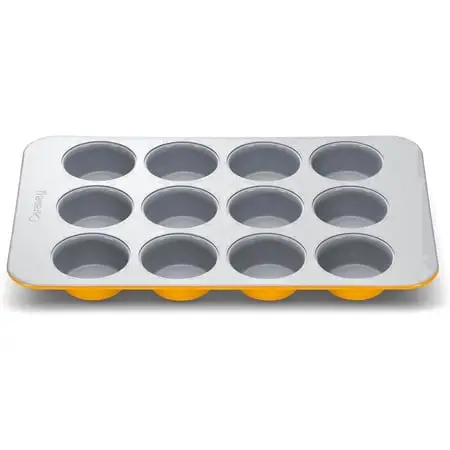
Quick Look: Best Muffin Tins for 2026
| Muffin Tin | Best For | Material | Why I Like It |
|---|---|---|---|
| Caraway 12-Cup Muffin Pan | Best Overall | Ceramic-coated aluminized steel | Easy release, even heating, beautiful design |
| USA Pan 12-Cup Muffin Pan | Best Professional-Style Pan | Aluminized steel | Commercial-style construction and dependable baking |
| Nordic Ware Naturals 12-Cavity Muffin Pan | Best Uncoated Aluminum | Pure aluminum | Excellent heat conductivity and even browning |
| OXO Good Grips Non-Stick Pro 12-Cup Muffin Pan | Best Everyday Nonstick | Aluminized steel/ceramic nonstick | Easy release and straightforward everyday use |
| Wilton 12-Cup Muffin Pan | Best Budget Pick | Steel | Affordable and beginner-friendly |
| Nordic Ware Jumbo Muffin Pan | Best for Oversized Bakery Muffins | Aluminum | Larger wells designed for big bakery-style muffins |
What Makes a Good Muffin Tin?
Before getting into my favorites, it helps to understand why muffin pans can produce surprisingly different results.
A great muffin pan needs to do several things well.
- Even Heat Distribution
This is probably the biggest factor for me.
You want heat moving evenly around every muffin cavity so you don’t end up with six perfectly golden muffins, three pale ones, and three that look like they spent an extra weekend in the oven.
Materials such as aluminum and aluminized steel are popular because they conduct heat effectively.
- Sturdy Construction
Thin muffin tins can warp or flex when heated.
A heavier, well-constructed pan feels much more secure when you’re moving twelve batter-filled cups into the oven—and it tends to hold up better through repeated baking.
- Good Muffin Release
Nothing ruins a beautiful muffin faster than leaving the entire bottom half stuck inside the pan.
A quality nonstick or ceramic surface can make muffin removal dramatically easier, particularly when you’re baking without paper liners.
- Proper Muffin-Cup Size
Standard 12-cup muffin pans are what most recipes are written for.
However, if your goal is those enormous coffee-shop muffins with towering tops, a jumbo muffin tin can be worth adding to your bakeware collection.
1. Caraway 12-Cup Muffin Pan — Best Overall
If you’ve spent any time around my kitchen, this choice probably isn’t shocking.
The Caraway 12-Cup Muffin Pan is the pan I would choose for the home baker who wants excellent everyday performance combined with extremely easy cleanup.
Caraway uses an aluminized steel core, which helps the pan heat quickly and evenly. The baking surface has Caraway’s ceramic nonstick coating, and the company states that it is made without PTFE, PFOA, PFAS, lead, and cadmium.
Another impressive feature is its temperature rating: the pan is oven-safe up to 550°F.
That’s much higher than you’ll normally need for muffins, but I like having bakeware that isn’t limiting me.
Why I Love It
As someone who bakes constantly, easy release matters to me almost as much as even baking.
Muffins should lift out beautifully without requiring you to scrape around every cavity, and cleanup shouldn’t turn into another baking project.
This is where ceramic-coated bakeware really shines.
I also love that the Caraway pan looks like something I actually want sitting in my kitchen. Bakeware doesn’t need to be beautiful—but when performance and design come together, I’m certainly not complaining.
Best for: Home bakers who want premium nonstick performance, easy cleanup, and a beautiful pan they’ll use constantly.
Potential downside: It’s considerably more expensive than a basic muffin tin, so occasional bakers may prefer one of the budget options below.
My Caraway Tip
Even with a great nonstick surface, I still recommend treating your bakeware gently. Avoid metal utensils that can damage the coating, and follow the manufacturer’s cleaning instructions to help preserve the surface.
If you’re already building a Caraway bakeware collection, this is one of the pieces I think makes the most sense because muffin pans are useful for much more than muffins.
Think:
- Cupcakes
- Egg bites
- Mini frittatas
- Baked oatmeal cups
- Individual cheesecakes
- Cornbread muffins
- Breakfast cups
- Mini meatloaves
It’s one of those pans that can quietly become a kitchen workhorse.
2. USA Pan 12-Cup Muffin Pan — Best Professional-Style Muffin Tin
USA Pan has earned a strong reputation among serious home bakers, and its 12-cup muffin pan has a distinctly commercial-kitchen feel.
It’s constructed from aluminized steel, a material commonly chosen for its durability and baking performance. USA Pan also uses its Americoat silicone nonstick coating to help with food release and cleanup.
If appearance isn’t especially important to you and you simply want sturdy, functional bakeware, this is an excellent option.
Why I Like It
The construction is the selling point.
This feels much closer to the type of straightforward bakeware you’d expect in a working kitchen. It’s designed for someone who bakes often and wants repeatable results.
Best for: Serious bakers who prioritize function and durability.
Potential downside: It doesn’t have the polished aesthetic of Caraway, and the design is much more utilitarian.
3. Nordic Ware Naturals 12-Cavity Muffin Pan — Best Uncoated Aluminum Muffin Tin
Nordic Ware Naturals 12-Cavity Muffin Pan
If you prefer uncoated bakeware, Nordic Ware deserves a serious look.
The Naturals 12-Cavity Muffin Pan is made from pure aluminum with a reinforced steel rim designed to resist warping.
The biggest advantage here is heat conductivity.
Aluminum conducts heat extremely well, helping muffins bake and brown consistently. Nordic Ware rates this particular pan for oven temperatures up to 500°F and backs it with a lifetime warranty.
Why I Like It
This is a wonderfully uncomplicated baking pan.
There isn’t a ceramic or traditional nonstick coating to baby. Instead, you’re getting an aluminum workhorse that prioritizes even baking.
Grease the cavities properly or use muffin liners and you’re ready to bake.
Best for: Bakers who want an uncoated muffin pan.
Potential downside: You’ll need to pay more attention to greasing the cavities than you would with a highly nonstick ceramic pan.
4. OXO Good Grips Non-Stick Pro 12-Cup Muffin Pan — Best Everyday Nonstick
OXO makes some of my favorite practical kitchen tools because their products tend to focus heavily on usability.
Their Non-Stick Pro muffin-pan options are a nice middle ground for someone who wants dependable nonstick bakeware without necessarily jumping into a complete premium bakeware collection.
An aluminized-steel construction combined with ceramic nonstick provides the two things most home bakers care about: consistent baking and easier release.
Best for: Everyday muffins, cupcakes, egg bites, and family baking.
Potential downside: If avoiding coated bakeware altogether is your priority, I’d choose the uncoated Nordic Ware instead.
5. Wilton 12-Cup Muffin Pan — Best Budget Muffin Tin
You absolutely do not need to spend $50 on a muffin tin to bake delicious muffins.
For beginner bakers, occasional bakers, college kitchens, or anyone building a bakeware collection on a budget, Wilton’s basic 12-cup muffin pans are worth considering.
They’re straightforward, widely available, and affordable.
I would rather see someone buy an inexpensive metal muffin tin and learn proper muffin-baking technique than spend a fortune assuming the pan alone will magically create giant muffin tops.
Because it won’t.
Technique still matters.
Best for: Beginners and budget-conscious bakers.
Potential downside: Premium pans generally offer heavier construction, better long-term durability, and more refined nonstick performance.
6. Nordic Ware Jumbo Muffin Pan — Best for True Bakery-Style Muffins
Here’s where things get interesting.
If by “bakery-style muffin” you mean the enormous domed muffins sitting behind the glass at your favorite bakery, you may actually want a jumbo muffin pan rather than a standard one.
Nordic Ware specifically describes its jumbo muffin pan as having deep, wide wells for oversized, domed bakery-style muffins.
That’s an important distinction.
A standard muffin pan can absolutely produce tall muffin tops, but it won’t magically transform a standard recipe into the enormous muffins you’d find at a coffee shop.
Best for: Oversized blueberry, chocolate chip, banana nut, lemon poppy seed, and streusel-topped muffins.
Caraway vs. USA Pan: Which Is Better?
This is probably the comparison I would personally want to know before buying.
Choose Caraway if: you prioritize ceramic nonstick, easy cleanup, beautiful design, high-temperature capability, and cookware made without PTFE/PFOA/PFAS.
Choose USA Pan if: you want commercial-inspired bakeware, don’t care much about appearance, and prioritize a sturdy aluminized-steel workhorse.
For my kitchen?
I’m choosing Caraway.
I already use and love Caraway cookware and bakeware, and I appreciate having pieces that perform well while keeping the overall collection cohesive.
But USA Pan is an excellent choice for the baker who cares almost exclusively about performance.
Caraway vs. Nordic Ware: Which Is Better?
This comparison really comes down to coated versus uncoated bakeware.
Caraway gives you a ceramic nonstick surface over an aluminized-steel core.
Nordic Ware’s classic Naturals muffin pan uses uncoated pure aluminum.
The Nordic Ware pan therefore appeals to bakers who want straightforward, uncoated aluminum bakeware and excellent heat conductivity.
Caraway appeals more to the baker who prioritizes easy food release and cleanup.
I don’t think one philosophy is universally better. They’re simply different approaches.
What Size Muffin Tin Is Best?
For most people, I recommend starting with a 12-cup standard muffin pan.
That’s the size most conventional muffin and cupcake recipes expect.
Once you have that, consider adding specialty pans.
Standard Muffin Tin
Best for everyday:
- Blueberry muffins
- Banana muffins
- Chocolate chip muffins
- Cupcakes
- Corn muffins
- Egg bites
Jumbo Muffin Tin
Best for:
- Bakery-style blueberry muffins
- Jumbo chocolate muffins
- Coffee-shop muffins
- Streusel muffins
- Large breakfast muffins
Mini Muffin Tin
Best for:
- Parties
- Kids
- Brunch buffets
- Mini cupcakes
- Bite-size appetizers
If I could only own one, I’d choose the standard 12-cup pan because it’s by far the most versatile.
Aluminum vs. Steel vs. Ceramic-Coated Muffin Pans
Material makes a noticeable difference in bakeware.
Aluminum
Aluminum conducts heat efficiently, which is one reason it remains so popular in professional and home baking.
It tends to produce consistent baking and browning.
Aluminized Steel
Aluminized steel combines the strength of steel with aluminum’s desirable baking properties.
Both Caraway and USA Pan use aluminized-steel construction in their muffin pans, although their coatings and overall designs differ considerably.
Ceramic Nonstick
Ceramic-coated bakeware gives you the convenience of easy food release.
This is one of my favorite features of the Caraway muffin pan.
For sticky blueberry juices, chocolate chips, cheese, egg cups, or muffins baked directly inside the cavities, easy cleanup is a major advantage.
Light vs. Dark Muffin Pans
Here’s a baking detail that’s easy to overlook.
Darker pans generally absorb heat more readily, which can encourage faster or deeper browning.
Lighter-colored aluminum pans tend to reflect more heat and can produce gentler browning.
Neither is automatically better.
But if you switch between dramatically different pans and suddenly notice your muffins getting darker around the edges, your pan may be part of the reason.
Start checking your muffins a few minutes earlier whenever you’re baking with an unfamiliar pan.
How to Get Tall Bakery-Style Muffin Tops
Buying the best muffin tin helps, but your technique matters too.
Don’t Overmix Your Batter
This is muffin rule number one.
Mix the dry and wet ingredients only until everything is incorporated.
Overmixing develops gluten and can leave muffins dense or tough instead of soft and tender.
Fill the Muffin Cups Generously
Those tiny half-filled muffin cavities aren’t going to suddenly develop enormous tops.
For bakery-style muffins, recipes frequently require generously filled cavities.
Follow the specific recipe rather than automatically filling every muffin cup two-thirds full.
Try the Alternate-Cup Method
This has become one of my favorite tricks for creating impressive muffin tops.
Instead of filling all twelve cavities, fill alternating cavities and leave space between the muffins.
The additional room can improve airflow around each muffin. It’s a technique also recommended by baking professionals for encouraging better rise.
You’ll bake fewer muffins at once, but the visual result can be worth it.
Start With a Higher Oven Temperature—When the Recipe Calls for It
Some bakery-style muffin recipes begin at a higher oven temperature before reducing the heat.
That initial burst of heat can encourage rapid oven spring.
However, don’t automatically use this technique with every recipe. Follow a recipe specifically developed and tested for the method.
Let Thick Muffin Batter Rest
Depending on the recipe, resting the batter briefly can allow the flour to hydrate and may improve the final texture and rise.
Again, follow your recipe here rather than applying one rule to every muffin batter.
Don’t Leave Finished Muffins Sitting in the Pan Forever
After a brief cooling period, transfer the muffins to a rack.
Leaving them inside a hot pan too long can trap moisture around the bottoms.
Should You Use Muffin Liners?
It depends on what you’re baking.
I use liners when I want:
- Easy serving
- Less cleanup
- Portable muffins
- Cupcakes
- Muffins for parties or gifting
I often skip them when I want:
- More browned edges
- A slightly crisper exterior
- A more rustic bakery appearance
With a good nonstick muffin tin, liners become more of a preference than a necessity.
Do You Still Need to Grease a Nonstick Muffin Tin?
I usually recommend following the manufacturer’s instructions for your specific pan.
“Nonstick” doesn’t necessarily mean every batter will fall effortlessly from every pan forever.
Recipes containing sticky fruit, cheese, caramelized sugar, or other high-sugar ingredients can behave differently from a basic vanilla cupcake.
When in doubt, a light coating of the recommended baking fat or a liner provides extra insurance.
What I Look for When Buying Bakeware
I’ve baked enough over the years to know that flashy kitchen gadgets don’t necessarily make better food.
When I’m investing in bakeware, I look for:
- Even heating
- Sturdy construction
- Reliable food release
- Comfortable handling
- Easy cleanup
- Useful sizes
- Durability
- Versatility
I would much rather own one muffin tin I reach for every week than five cheap pans taking up space in a cabinet.
Are Expensive Muffin Tins Worth It?
Sometimes.
A $50+ muffin pan isn’t going to rescue a poorly formulated muffin recipe.
But premium bakeware can provide advantages such as sturdier construction, more predictable heat distribution, improved release, higher-quality coatings, and better long-term durability.
If you bake once a year, buy the affordable pan.
If you’re pulling muffins, cupcakes, egg bites, mini cheesecakes, and breakfast cups out of your oven every week, upgrading makes much more sense.
My Final Pick: The Best Muffin Tin for Home Bakers
After comparing the options, my personal winner is the Caraway 12-Cup Muffin Pan.
The combination of an aluminized-steel core, ceramic nonstick surface, easy cleanup, 550°F oven rating, and Caraway’s focus on materials makes it particularly appealing for my style of everyday baking.
And yes—I fully admit that I’m already a Caraway fanatic.
But that’s also why I keep using their bakeware.
For someone who wants traditional uncoated aluminum, I’d choose the Nordic Ware Naturals 12-Cavity Muffin Pan.
For a commercial-style workhorse, I’d look at USA Pan.
And if your number-one goal is creating enormous coffee-shop muffins, buy a jumbo muffin pan.
The important thing is matching your muffin tin to the way you actually bake.
Because once you find a great muffin recipe and pair it with the right pan?
That’s when homemade muffins start looking like they belong behind the glass at your favorite bakery.
More Baking Guides and Recipes to Try
Once you have the right muffin pan, put it to work!
Check out my other buying guides like the best standing mixers, air fryers, kitchen knife sets, and sustainable cookware.
Try my favorite blueberry muffins, chocolate chips muffins, and bakery-style Costco copycat lemon raspberry muffins recipe!