If you’ve spent any time scrolling through high-protein recipes lately, you’ve probably noticed two ingredients showing up everywhere: cottage cheese and Greek yogurt. Both can add protein, moisture, creaminess, and richness to baked goods but they don’t behave exactly the same way in the oven.
So, cottage cheese vs Greek yogurt in baking: which one should you use?
The short answer: Greek yogurt is usually the easier all-purpose baking substitute, while cottage cheese is especially useful when you want more structure, richness, or a higher-protein result. The best choice ultimately depends on what you’re baking and the texture you want.
I use both ingredients in my kitchen, and they each have their place. Greek yogurt can disappear almost seamlessly into muffin, cake, and quick-bread batters. Cottage cheese can create surprisingly creamy cheesecakes, fudgy brownies, protein-packed breads, and other recipes—but it often works best when it’s blended first.
Below, I’m breaking down cottage cheese vs Greek yogurt for baking, including texture, protein, moisture, substitutions, the best baked goods for each, and when you absolutely should or shouldn’t swap one for the other.
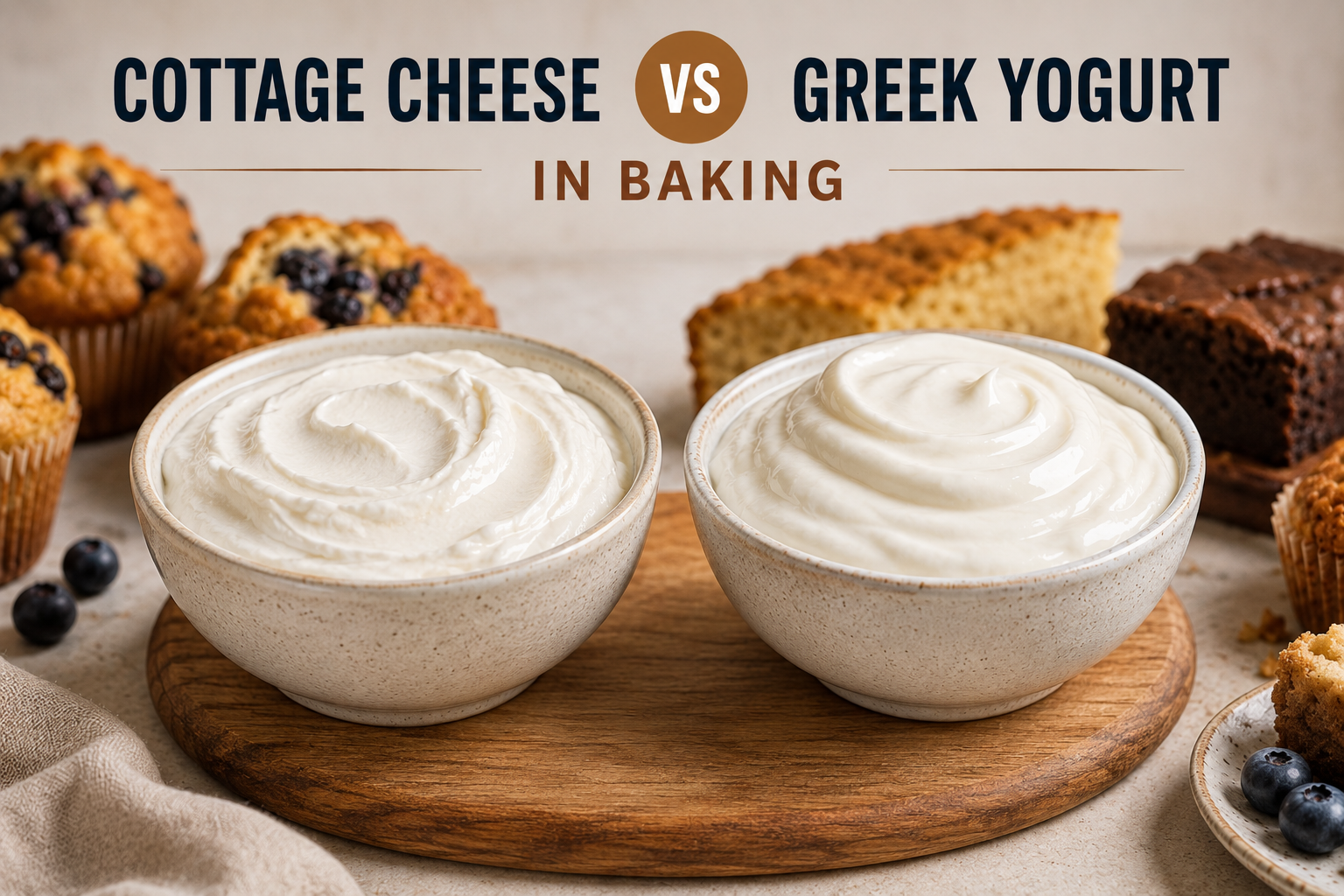
Cottage Cheese vs Greek Yogurt in Baking: Quick Answer
If you only need the quick version, here it is:
Use Greek yogurt when you want:
- A smooth batter
- Extra moisture
- A little tang
- Tender muffins and cakes
- An easy replacement for sour cream
- An ingredient that blends into a recipe without dramatically changing the texture
Use cottage cheese when you want:
- More protein
- A creamy or slightly denser texture
- Cheesecake-style richness
- Protein brownies, breads, muffins, or breakfast bakes
- An alternative to heavier creamy ingredients
- More structure in certain recipes
And my biggest cottage cheese baking tip?
Blend it.
If you want cottage cheese to behave more like Greek yogurt, sour cream, or another smooth dairy ingredient, blending it until completely creamy makes a huge difference.
What Is the Difference Between Cottage Cheese and Greek Yogurt?
Cottage cheese and Greek yogurt may look like similar high-protein dairy ingredients, but they’re produced differently.
Greek yogurt is yogurt that has been strained to remove some of its whey. This creates its characteristic thick, creamy consistency.
Cottage cheese is made from milk curds. Those curds are responsible for its recognizable lumpy texture.
That difference matters when you bake with them.
Greek yogurt is already smooth, so it incorporates easily into cake and muffin batters.
Cottage cheese contains curds, meaning it may remain slightly textured unless you blend it first.
Once cottage cheese is blended, however, it becomes incredibly creamy—and that opens up an entirely different world of baking possibilities.
Cottage Cheese vs Greek Yogurt Nutrition
Both cottage cheese and Greek yogurt can be excellent sources of protein, but nutrition varies significantly depending on the brand, milk-fat percentage, serving size, and formulation.
A typical serving of either may provide a substantial amount of protein, which is one reason both have become popular ingredients in higher-protein recipes.
Instead of assuming cottage cheese will always have more protein, check the nutrition label on the specific products you’re using. Some Greek yogurts are exceptionally high in protein and may equal or exceed cottage cheese.
Both can also provide nutrients such as:
- Protein
- Calcium
- Vitamin B12
- Phosphorus
- Riboflavin
From a baking perspective, though, nutrition is only half the story.
The bigger question is how each ingredient changes your recipe.
What Does Greek Yogurt Do in Baking?
Greek yogurt is one of my favorite ingredients for adding moisture without making baked goods feel overly heavy.
Its creamy texture blends easily into batter, while its acidity can contribute to tenderness and work with baking soda in recipes formulated around acidic ingredients.
Greek yogurt can help create:
- Moist cakes
- Tender muffins
- Soft quick breads
- Creamy cheesecakes
- Thick pancake batter
- Soft cookies
- Moist brownies
It also has a mild tang that works especially well in lemon, blueberry, chocolate, banana, and other strongly flavored baked goods.
Greek Yogurt Is Especially Good for Muffins
Greek yogurt is one of my first choices for muffins because it adds moisture without requiring much extra preparation.
You can scoop it directly into the batter.
No blender.
No food processor.
No additional step.
That makes Greek yogurt especially convenient for easy, one-bowl baking recipes.
What Does Cottage Cheese Do in Baking?
Cottage cheese is a little more interesting because its behavior depends heavily on how you use it.
Add it directly from the container and you may have visible curds or small pockets of cheese throughout your recipe.
Blend it until smooth and suddenly it becomes a thick, creamy ingredient that can work beautifully in baked goods.
Blended cottage cheese can add:
- Creaminess
- Moisture
- Protein
- Richness
- Body
- Structure
- A slightly denser texture
This is why cottage cheese has become such a popular ingredient in protein-focused baking.
Should You Blend Cottage Cheese Before Baking?
In many recipes, yes.
This is probably the most important tip in this entire guide.
Place your cottage cheese in a blender or food processor and blend until it becomes completely smooth and creamy.
You’re essentially turning those curds into a thick cream.
I especially recommend blending cottage cheese for:
- Cheesecake
- Brownies
- Muffins
- Cakes
- Pancakes
- Quick breads
- Protein desserts
- Smooth batters
There are exceptions. Some breakfast bakes, savory breads, casseroles, and rustic recipes work perfectly well with unblended cottage cheese.
But if you’re replacing Greek yogurt with cottage cheese, blending it first will usually give you the closest texture.
Cottage Cheese vs Greek Yogurt for Muffins
Winner: Greek Yogurt for classic muffins
For traditional bakery-style muffins, I generally reach for Greek yogurt.
Greek yogurt mixes smoothly into the batter and helps create a moist, tender crumb.
It works beautifully in:
- Blueberry muffins
- Banana muffins
- Chocolate chip muffins
- Lemon muffins
- Chocolate muffins
- Pumpkin muffins
Cottage cheese can absolutely work in muffins, particularly higher-protein muffin recipes, but I recommend blending it first.
Cottage cheese muffins may also have a slightly different crumb than traditional muffins, depending on the rest of the recipe.
Best for classic muffins: Greek yogurt
Best for protein-focused muffins: Cottage cheese can be excellent.
Cottage Cheese vs Greek Yogurt for Cakes
Winner: Greek Yogurt
Greek yogurt generally wins for traditional cakes.
It incorporates easily into cake batter and can help produce a soft, moist crumb without leaving any noticeable texture.
It’s particularly useful in:
- Lemon cake
- Chocolate cake
- Coffee cake
- Bundt cake
- Loaf cake
- Snack cake
Cottage cheese can work in cake recipes, but I wouldn’t automatically substitute it into every cake.
If you’re experimenting with cottage cheese cake, blend it extremely well before adding it to your batter.
Cottage Cheese vs Greek Yogurt for Cheesecake
Winner: It depends on the cheesecake.
This is where things get interesting.
Both ingredients can make fantastic cheesecake.
Greek yogurt works particularly well when you’re looking for a tangy, creamy cheesecake filling.
Blended cottage cheese can make an incredibly creamy cheesecake while adding protein and creating a lighter alternative to recipes made entirely with cream cheese.
Cottage cheese is particularly useful in recipes intentionally developed as cottage cheese cheesecake.
Rather than viewing it only as a substitution, I prefer to treat cottage cheese cheesecake as its own style of dessert.
Cottage Cheese vs Greek Yogurt for Brownies
Winner: Cottage cheese for protein brownies; Greek yogurt for an easy traditional swap
Both can work.
Greek yogurt can add moisture to brownies and is easy to incorporate into the batter.
Blended cottage cheese, however, is particularly interesting in brownie recipes because it can help create a dense, fudgy texture while increasing the protein content.
The key word is blended.
Nobody wants random cottage cheese curds hiding inside a fudgy chocolate brownie.
Blend your cottage cheese until silky before mixing it into the brownie batter.
Cottage Cheese vs Greek Yogurt for Pancakes
Both are excellent.
Greek yogurt pancakes tend to be:
- Tender
- Moist
- Thick
- Slightly tangy
Cottage cheese pancakes can be:
- Protein-rich
- Soft
- Creamy
- Substantial
- Very satisfying
If you want traditional fluffy pancakes, Greek yogurt may be the easier option.
If protein is one of your priorities, cottage cheese is definitely worth experimenting with.
Cottage Cheese vs Greek Yogurt for Quick Breads
Winner: Greek yogurt for traditional recipes
Think banana bread, lemon loaf, pumpkin bread, blueberry bread, and zucchini bread.
Greek yogurt fits beautifully into these recipes because it adds moisture while disappearing into the batter.
Cottage cheese can work too, especially in protein-focused quick breads, but blending it first will usually give you better results.
Cottage Cheese vs Greek Yogurt for Cookies
Cookies are a little trickier.
Adding extra moisture to cookie dough can dramatically change how cookies spread and bake.
Greek yogurt can work in recipes specifically formulated for it, but replacing butter or another ingredient with yogurt without adjusting the rest of the recipe may produce cakier cookies.
Cottage cheese can present the same problem.
It may make cookies softer and more cake-like depending on the recipe.
For cookies, I recommend following a recipe developed specifically for cottage cheese or Greek yogurt rather than making an automatic substitution.
Can You Substitute Cottage Cheese for Greek Yogurt in Baking?
Sometimes.
But I wouldn’t treat the two ingredients as universally interchangeable.
For recipes where Greek yogurt mainly provides moisture and creaminess, blended cottage cheese may work well.
Start by blending the cottage cheese until completely smooth.
A 1:1 volume substitution can be a reasonable starting point in forgiving recipes, but it isn’t a guarantee. Cottage cheese and Greek yogurt vary in moisture, acidity, fat, and protein, so the final texture and rise can change.
This substitution tends to be more forgiving in:
Use more caution with delicate cakes, cookies, or recipes where the yogurt’s acidity is important to the leavening.
Can You Substitute Greek Yogurt for Cottage Cheese?
Again, sometimes.
Greek yogurt may work in recipes where cottage cheese has been blended and is primarily contributing creaminess and moisture.
However, cottage cheese can provide more body and a different protein structure, so switching to Greek yogurt may create a softer or wetter result.
If cottage cheese is a major structural component of the recipe rather than simply a moisture-adding ingredient, I wouldn’t automatically swap it.
Greek Yogurt vs Blended Cottage Cheese
This is actually the comparison I think makes the most sense.
Regular cottage cheese and Greek yogurt look dramatically different.
Blended cottage cheese and Greek yogurt are much closer competitors.
Once blended, cottage cheese becomes:
- Smooth
- Thick
- Creamy
- Easy to mix into batter
- Much less noticeable in finished baked goods
If you’ve avoided cottage cheese because of its texture, don’t judge it until you’ve tried blending it.
Which Is Better for High-Protein Baking?
There isn’t one automatic winner.
Both can contribute meaningful protein, and the exact amount depends on the brand and serving size you use.
Cottage cheese has become especially popular in protein baking because its texture and protein content work beautifully in recipes designed around it.
But high-protein Greek yogurt can be equally impressive.
If maximizing protein is your goal, compare labels and choose the product that works best with the recipe’s texture and moisture requirements.
Full-Fat vs Low-Fat: Does It Matter?
Yes.
Fat affects tenderness, richness, moisture, and mouthfeel.
Full-fat Greek yogurt or cottage cheese generally produces richer results.
Low-fat varieties can still work very well, particularly in recipes designed for them.
Fat-free versions may produce slightly different results because removing fat changes the texture and moisture balance.
My general baking preference is to use plain Greek yogurt or cottage cheese with some fat unless the recipe specifically calls for fat-free.
Always Use Plain, Unsweetened Varieties
Unless your recipe specifically calls for flavored yogurt, use plain.
Vanilla or fruit-flavored Greek yogurt can contain added sugars and flavors that alter the sweetness and flavor of your baked goods.
The same idea applies to cottage cheese.
For baking, I prefer a simple cottage cheese without unnecessary flavor additions.
What About Sodium?
This is one difference people sometimes overlook.
Cottage cheese can contain considerably more sodium than plain Greek yogurt, although the amount varies by brand.
In sweet baked goods, that doesn’t necessarily mean your dessert will taste salty, but it’s something worth checking if you’re monitoring sodium or using a particularly salty cottage cheese.
Cottage Cheese vs Greek Yogurt Baking Comparison
| Baking Factor | Cottage Cheese | Greek Yogurt |
|---|---|---|
| Texture | Curdy unless blended | Naturally smooth |
| Preparation | Often best blended | Ready to use |
| Protein | Usually high; varies by brand | Usually high; varies by brand |
| Moisture | Varies significantly | Thick and creamy |
| Flavor | Mild, slightly salty | Tangy |
| Traditional cakes | Good with adjustments | Excellent |
| Muffins | Great for protein recipes | Excellent |
| Brownies | Excellent for protein/fudgy recipes | Excellent for moisture |
| Cheesecake | Excellent when blended | Excellent |
| Pancakes | Excellent | Excellent |
| Quick breads | Good | Excellent |
| High-protein recipes | Excellent | Excellent |
| Easy substitutions | Moderate | Very easy in many recipes |
Which One Should You Use?
Here’s my simple rule.
Choose Greek Yogurt If…
You’re making a traditional baked good and primarily want moisture, tenderness, and creaminess.
Greek yogurt is especially good for cakes, muffins, quick breads, pancakes, and recipes where you would normally use sour cream.
Choose Cottage Cheese If…
You’re intentionally making a higher-protein baked good or want extra creaminess and body.
It’s especially good for protein brownies, cottage cheese cheesecake, pancakes, breakfast bakes, and recipes designed specifically around cottage cheese.
Choose Blended Cottage Cheese If…
You want many of the benefits of cottage cheese without the curds.
For most sweet baking applications, this is my preferred way to use it.
Common Mistakes When Baking With Cottage Cheese
- Not Blending It
Unless you specifically want visible curds, blend cottage cheese until completely smooth.
- Assuming Every Swap Is 1:1
Baking is chemistry.
Changing moisture, fat, protein, or acidity can change the final product.
- Using an Extremely Wet Cottage Cheese
Some brands contain more liquid than others. That extra moisture can loosen your batter.
- Expecting Traditional Texture From a Protein Recipe
A cottage cheese brownie or high-protein muffin may not have exactly the same texture as a traditional bakery recipe loaded with butter and sugar.
That doesn’t mean it isn’t delicious—it simply means the ingredients are doing different jobs.
Common Mistakes When Baking With Greek Yogurt
- Using Flavored Yogurt
Plain is usually best unless the recipe says otherwise.
- Replacing Too Much Fat
Greek yogurt can replace some higher-fat ingredients in certain recipes, but removing all the fat can change tenderness and flavor.
- Ignoring the Acidity
Greek yogurt is acidic. If your recipe relies on that acidity to interact with baking soda, replacing it with another ingredient may affect the rise.
- Using Regular Yogurt Without Adjusting
Regular yogurt is generally thinner than Greek yogurt, so the two shouldn’t always be treated as identical.
Tips for Baking With Cottage Cheese and Greek Yogurt
For the best results:
- Bring dairy ingredients closer to room temperature when the recipe calls for it.
- Blend cottage cheese for smooth desserts and batters.
- Use plain, unsweetened products.
- Compare protein and sodium labels between brands.
- Don’t overmix muffin or cake batter.
- Remember that different brands contain different amounts of moisture.
- Follow recipes specifically formulated for these ingredients whenever possible.
- If experimenting with substitutions, test one change at a time.
My Final Verdict: Cottage Cheese or Greek Yogurt?
There really isn’t one winner because they solve slightly different baking problems.
For classic everyday baking, I’d choose Greek yogurt.
It’s easy, smooth, versatile, and fantastic for adding moisture to muffins, cakes, pancakes, and quick breads.
For protein-focused baking, I love blended cottage cheese.
Once it’s completely smooth, cottage cheese can transform into a creamy baking ingredient that works beautifully in brownies, cheesecakes, pancakes, breads, and high-protein desserts.
So instead of asking which ingredient is universally better, ask:
What do I want this ingredient to do in my recipe?
For moisture and tenderness → Greek yogurt.
For creaminess, body, and protein-focused baking → cottage cheese.
And when you’re unsure?
Blend the cottage cheese and start experimenting.
More Cottage Cheese Recipes to Try
If you’ve got a container of cottage cheese sitting in your refrigerator, don’t stop at savory meals. Cottage cheese can be surprisingly versatile in both baking and high-protein recipes. Try it in cottage cheese brownies, cottage cheese cheesecake, cottage cheese pancakes, cottage cheese bagels, cottage cheese flatbread, cottage cheese cookie dough, or even cottage cheese chocolate mousse. These recipes are also a great way to see how dramatically the texture changes once cottage cheese is blended smooth.