If you’re brand new to baking, I’m going to tell you something I wish someone had told me years ago: baking gets a whole lot easier once you understand the little things that recipes don’t always explain.
You can follow a recipe exactly and still wonder why your cookies spread into one giant cookie, your cake came out dry, or your muffins looked nothing like the tall bakery-style ones in the photo.
I’ve been there.
The good news? You don’t need fancy equipment, professional training, or a pantry filled with specialty ingredients to become a good baker. You need a reliable recipe, a little patience, and a handful of basic baking rules that make a surprisingly big difference.
These are my 10 best baking tips for beginners the things I wish someone had explained to me when I first started baking.
And yes, some of them seem almost too simple. Those are usually the ones that matter most.
1. Read the Entire Recipe Before You Start
I know. This sounds like the most boring baking advice ever.
But please do it.
One of the easiest beginner baking mistakes is starting a recipe after reading only the ingredient list.
Halfway through, you suddenly discover that the butter was supposed to be softened, the eggs needed to be room temperature, the dough has to chill for two hours, or the cheesecake needs several hours to cool before serving.
Before you pull out a single mixing bowl, read the recipe from beginning to end.
Pay attention to:
- Ingredient temperatures
- Chilling or resting times
- Oven temperature
- Pan size
- Mixing instructions
- Baking time
- Cooling time
- Any ingredients that are divided and used in multiple steps
I also like to pull out all of my ingredients before I start. It makes the entire process smoother and helps prevent the dreaded moment when you realize you’re out of baking powder after everything else is already in the bowl.
Beginner baking tip: Prep first, bake second.
2. Measuring Flour Correctly Matters More Than You Think
If I could give a new baker only one piece of advice, this would be high on my list.
Stop scooping flour directly out of the bag with your measuring cup.
It’s incredibly easy to pack too much flour into the cup, and that extra flour can leave cakes dry, muffins dense, cookies thick, and breads heavier than they should be.
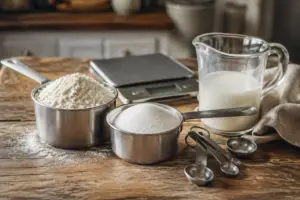
The most accurate way to measure flour is with a digital kitchen scale.
If a recipe gives the flour measurement in grams, use it.
No scale? Use the spoon-and-level method:
- Fluff the flour with a spoon.
- Spoon it lightly into your measuring cup.
- Don’t pack it down.
- Level the top with the straight edge of a knife.
For reference, 1 cup of all-purpose flour is generally around 120–125 grams, although you should always follow the weight specified by the recipe you’re using.
This one tiny change can completely transform your baking.
3. Room Temperature Ingredients Aren’t Just a Suggestion
Have you ever seen:
2 eggs, room temperature
…and used cold eggs straight from the refrigerator anyway?
Same.
Sometimes you’ll get away with it. Other times, you won’t.
When a baking recipe specifically calls for room-temperature butter, eggs, milk, cream cheese, or other dairy ingredients, there’s usually a reason.
Ingredients at similar temperatures combine more evenly. This can help create a smoother batter and a more consistent final texture.
This is particularly important when you’re making things like:
- Cakes
- Cupcakes
- Cheesecakes
- Buttercream
- Cookies that use creamed butter
- Pound cakes
How Do You Bring Eggs to Room Temperature Quickly?
Place cold eggs in a bowl of warm—not hot—water for about 5–10 minutes.
What About Butter?
Cut butter into small cubes and leave it on the counter while you gather the rest of your ingredients.
You want softened butter, not melted butter.
Softened butter should give slightly when pressed but still hold its shape.
4. Preheat Your Oven Before the Batter Is Ready
If the recipe says:
Preheat oven to 350°F.
That doesn’t mean turn the oven on when your cake batter is finished.
Your oven should already be fully heated before your baked goods go inside.
Why?
The initial heat helps baked goods rise, spread, set, and develop their structure properly. Putting cake batter, cookies, muffins, or biscuits into an oven that’s still slowly warming can change the final result.
I usually turn on my oven before I begin mixing.
Here’s Another Thing I Wish I Knew: Your Oven Might Be Lying to You
Just because the display says 350°F doesn’t necessarily mean the inside of the oven is actually 350°F.
Ovens can run hotter or cooler than their settings.
An inexpensive oven thermometer can help you determine your oven’s actual temperature.
If your cookies consistently burn before the recipe says they should be finished—or cakes regularly take much longer to bake—your oven temperature could be part of the problem.
5. Don’t Overmix Your Batter
This was one of my biggest early baking mistakes.
I assumed more mixing meant smoother batter, and smoother batter meant better baked goods.
Not necessarily.
Once flour is combined with liquid, gluten begins developing. Some gluten is important for structure, but too much mixing can make certain baked goods tough or dense.
This matters especially with:
- Muffins
- Pancakes
- Quick breads
- Cakes
- Brownies
- Biscuits
When a recipe says mix until just combined, take it seriously.
A few tiny streaks or lumps are often better than beating the batter for another two minutes trying to make it perfectly smooth.
What Does “Just Combined” Mean?
It means the dry ingredients have essentially disappeared into the batter and everything is evenly distributed.
Then stop.
Put the whisk down.
Step away from the bowl.
Your muffins will thank you.
6. Baking Powder and Baking Soda Are NOT the Same Thing
I wish these two ingredients had less similar names because they confuse so many new bakers.
Baking soda and baking powder are different leavening agents, and you usually cannot swap them 1:1.
Baking Soda
Baking soda needs an acidic ingredient to react properly.
That acid might come from ingredients such as:
- Buttermilk
- Yogurt
- Sour cream
- Lemon juice
- Molasses
- Natural cocoa powder
Baking Powder
Baking powder contains the components needed to create its leavening reaction and is commonly used when a recipe doesn’t contain enough acid to rely on baking soda alone.
Some recipes use both baking soda and baking powder because each is doing a specific job.
So if your recipe calls for baking powder, don’t automatically replace it with baking soda because that’s what you have in the pantry.
Baking is chemistry, and this is one place where that chemistry really matters.
7. Don’t Keep Opening the Oven Door
I know it’s tempting.
Your cake is rising beautifully. Your muffins have those gorgeous domed tops. You just want to peek.
Use the oven light.
Every time you open the oven door, heat escapes and the oven temperature drops. For delicate baked goods, especially cakes, cheesecakes, and soufflé-style desserts, a sudden temperature change can interfere with how they rise and set.
As a general rule, leave the oven door closed for most of the baking time.
When you’re getting close to the recommended baking time, that’s when you can begin checking for doneness.
And no, staring through the oven window for 20 minutes doesn’t make you impatient.
That’s part of baking.
8. Baking Time Is a Guide – Learn How to Tell When Something Is Done
Here’s something beginner bakers aren’t told enough:
The baking time in a recipe isn’t an absolute rule.
If a recipe says bake for 20–25 minutes, your muffins might be perfect at 19 minutes while someone else’s need 27.
Why?
Because baking time can be affected by:
- Your oven
- Your baking pan
- Ingredient temperature
- Batter temperature
- Pan placement
- Altitude
- The actual size of your cookies, muffins, or other portions
Start checking your baked goods around the lower end of the recommended time range.
How Do You Know When Baked Goods Are Done?
It depends on what you’re making.
Cakes: A toothpick inserted near the center should usually come out clean or with a few moist crumbs, depending on the recipe.
Muffins: The tops should spring back gently when touched.
Cookies: The edges may look set while the centers still appear slightly soft.
Brownies: A toothpick may have a few moist crumbs rather than coming out completely clean if you want fudgy brownies.
Cheesecake: The edges should look set while the center still has a slight jiggle.
Learning to recognize these visual clues will eventually make you a much more confident baker than relying on a timer alone.
9. Let Your Baked Goods Cool
This might be the hardest baking tip on this entire list.
You just pulled warm chocolate chip cookies out of the oven.
The kitchen smells incredible.
You want one immediately.
I understand.
But cooling is often part of the baking process.
Cookies continue setting on the baking sheet. Brownies firm up as they cool. Cakes need to cool before frosting. Cheesecakes need plenty of cooling and chilling time before slicing.
Cutting or moving baked goods too early can leave you with:
- Crumbling cakes
- Cookies that fall apart
- Gooey brownies
- Melted frosting
- Cheesecake that doesn’t hold its shape
Unless the recipe tells you otherwise, give your baked goods the cooling time they need.
A cooling rack is one of those inexpensive baking tools you’ll use over and over again.
10. Don’t Change Five Things the First Time You Make a Recipe
This is probably the beginner baking advice I wish more people followed.
You find a chocolate chip cookie recipe and immediately think:
“I’m going to use almond flour instead of all-purpose flour, coconut oil instead of butter, maple syrup instead of sugar, and flax eggs instead of regular eggs.”
And then the cookies don’t work.
Was it the recipe?
Maybe.
But now it’s almost impossible to know because the recipe wasn’t really tested anymore.
When you’re learning how to bake, make a recipe as written the first time whenever possible.
Once you understand how it’s supposed to look, taste, and feel, start experimenting.
Make one meaningful substitution at a time so you can see exactly what it changes.
This is especially important when swapping:
- Flour
- Sugar
- Eggs
- Butter or oil
- Leavening agents
- Dairy products
Baking substitutions can absolutely work, but they’re rarely as simple as exchanging equal amounts of two ingredients.
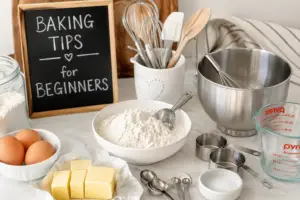
Bonus Baking Tip: Mise en Place Will Save You
Here’s one more because I couldn’t stop at ten.
The French term Mise en place basically means getting everything in place before you begin.
Measure your ingredients.
Prepare your pans.
Get out your mixing bowls.
Line your baking sheets.
Preheat your oven.
Then start.
It might seem like extra work, but it’s actually one of the easiest ways to make baking less stressful.
It also prevents you from realizing halfway through creaming your butter and sugar that you still need to measure six other ingredients.
Essential Baking Tools for Beginners
You don’t need to buy an entire professional baking setup before making your first batch of cookies.
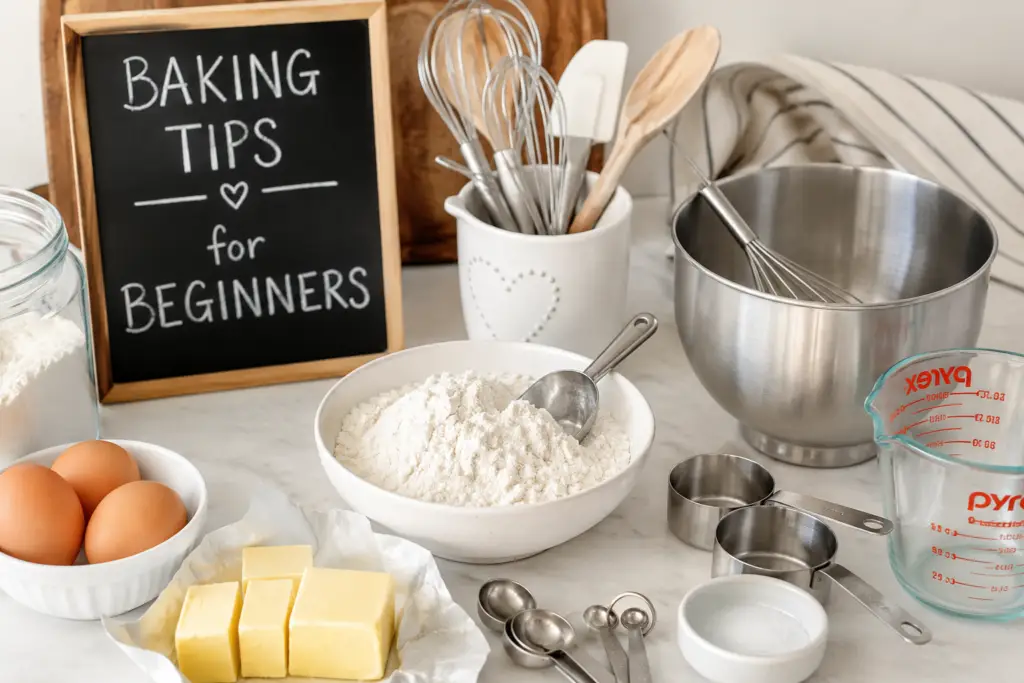
Start with a few basics:
- Digital kitchen scale
- Measuring cups and spoons
- Large and medium mixing bowls
- Whisk
- Silicone spatula
- Hand mixer
- Baking sheets
- 8- or 9-inch cake pan
- 12-cup muffin pan
- Loaf pan
- Parchment paper
- Cooling rack
- Oven thermometer
- Cookie scoop
Then add specialty equipment as you discover what you actually enjoy baking.
If you’re primarily a cookie baker, you’ll probably want great sheet pans and cookie scoops. If cakes become your thing, cake pans and a mixer become more important.
Buy for the baker you’re becoming—not for the imaginary bakery you think you need to build on day one.
5 Common Beginner Baking Mistakes
If something didn’t turn out perfectly, there’s usually an explanation.
1. My Cake Is Dry
Common causes include too much flour, overbaking, incorrect oven temperature, or overmixing.
2. My Cookies Spread Everywhere
Your butter may have been too warm, the dough may have needed chilling, or your flour measurement may have been off.
3. My Muffins Are Dense
Overmixing is a common culprit. Old baking powder or baking soda can also affect rise.
4. My Cake Sank in the Middle
Opening the oven too early, underbaking, incorrect leavening measurements, or improperly mixed batter can all contribute.
5. My Baked Goods Never Finish at the Recipe’s Exact Time
That’s normal. Recipes give you a useful range, but your oven and baking equipment matter too. Look for the recipe’s doneness cues rather than relying exclusively on minutes.
My Biggest Advice for Someone Learning How to Bake
Bake more.
That’s really it.
You can read every baking guide on the internet, but eventually you have to get flour on the counter.
You’ll learn what properly softened butter feels like.
You’ll recognize when cookie dough needs another few minutes in the refrigerator.
You’ll know what “just combined” batter actually looks like.
You’ll start noticing how your oven behaves.
And you’ll eventually stop panicking when something looks slightly different from the recipe photo.
Not every bake will be perfect—and that’s completely normal.
Some of the best baking lessons come from the cookies that spread too much, the cake you accidentally overbaked, or the loaf that didn’t rise the way you expected.
Figure out why it happened, change one thing, and bake again.
That’s how you become a better baker.
More Baking Guides to Try
If you’re learning how to bake, these are great topics to explore next: