Setting up your first kitchen is exciting… until you walk into a kitchen store and suddenly realize there are approximately 4,000 things someone is trying to convince you that you need.
Do you really need twelve different pans? Three types of spatulas? A garlic press? A stand mixer? An avocado slicer?
Probably not.
Whether you’re moving into your first apartment, first home, college apartment, or starting over with a new kitchen, the best approach is to begin with a small collection of kitchen essentials you’ll actually use. You can always add specialty gadgets later.
A functional kitchen doesn’t need to be overflowing with equipment. In fact, some of the things I reach for most are the simplest: a good skillet, saucepan, chef’s knife, cutting board, mixing bowls, baking sheet, and a handful of dependable utensils.
This first kitchen essentials checklist covers what I think is actually worth buying, what you can skip for now, and where it makes sense to invest a little more. Click here for 10% off your purchase applied at checkout.
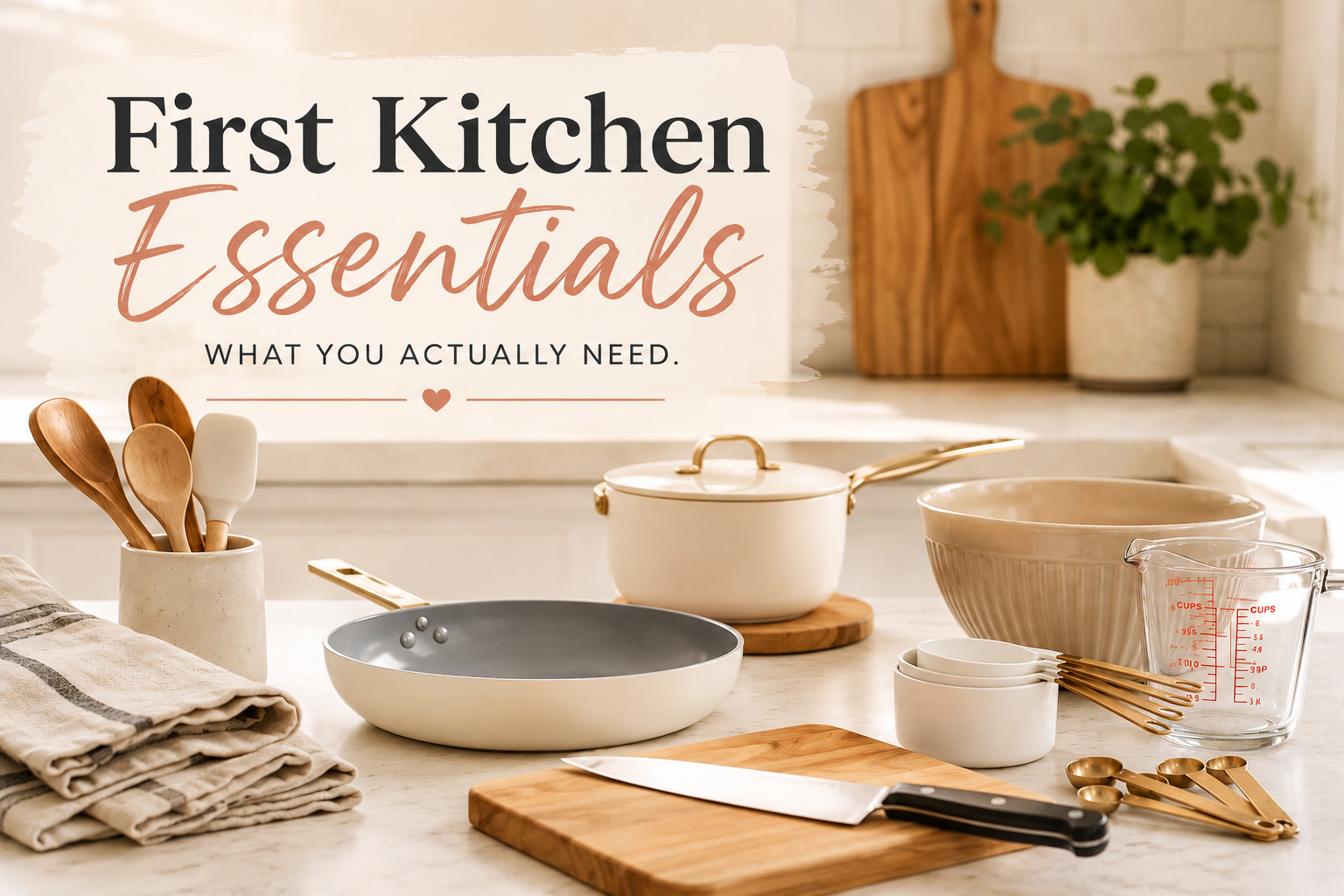
Quick First Kitchen Essentials Checklist
If you’re standing in an empty kitchen wondering where to begin, start here.
Cookware
- 8–10-inch frying pan
- Medium saucepan with lid
- Larger skillet or sauté pan
- Dutch oven or stockpot
Bakeware
- Half sheet pan
- 9×13-inch baking dish
- Muffin pan
- Cooling rack
Knives and Prep
- Chef’s knife
- Paring knife
- Serrated bread knife
- Large cutting board
- Measuring cups
- Measuring spoons
- Liquid measuring cup
- Mixing bowls
- Colander
Cooking Utensils
- Silicone spatula
- Wooden spoon
- Tongs
- Whisk
- Slotted spoon
- Ladle
- Vegetable peeler
- Can opener
Food Storage
- Food storage containers
- Freezer bags
- Aluminum foil
- Parchment paper
Small Appliances
- Toaster or toaster oven
- Blender
- Coffee maker, if you drink coffee
- Air fryer, if you’ll actually use it
That’s enough to make a surprising number of meals.
1. Start With a Good Frying Pan
If I could put only one pan into a brand-new kitchen, a frying pan would be near the top of the list.
You’ll use it for:
- Eggs
- Pancakes
- Grilled sandwiches
- Chicken
- Ground beef
- Vegetables
- Quesadillas
- Fish
- Reheating leftovers
For most kitchens, a 10- to 12-inch skillet is the most versatile size.
However, if you’re cooking primarily for one person or dealing with a tiny apartment kitchen, a smaller pan can be incredibly useful too.
2. Don’t Overlook Mini Cookware
One mistake people make when setting up their first kitchen is assuming bigger is always better.
It isn’t.
If you’re cooking for one or two people, a giant skillet isn’t necessary every time you want to fry an egg.
One of my favorite options for smaller kitchens is the Caraway Minis Duo.
The ceramic-coated set includes an 8-inch Mini Fry Pan and 1.75-quart Mini Sauce Pan, along with storage organizers. They’re designed specifically for smaller portions and compact kitchens.
I especially like the smaller sizes for things like:
- One or two eggs
- Oatmeal
- Heating soup
- Melting butter
- Warming sauces
- Small servings of pasta
- Sautéing vegetables
- Single-serving meals
- Reheating leftovers
Caraway’s ceramic Minis are compatible with all stovetops and oven-safe up to 550°F. The ceramic coating is also made without PTFE, PFOA, and PFAS.
If you’re building a kitchen from scratch and don’t have much cabinet space, a smaller cookware set can make much more sense than immediately purchasing a huge collection of pots and pans.
SugarFace Bakes Tip: Buy cookware based on how you actually cook, not the kitchen you imagine yourself having. If you’re usually cooking breakfast for one and dinner for two, smaller cookware may get more use than an enormous stockpot.
3. One Medium Saucepan
Next up: a saucepan.
A medium saucepan is one of those kitchen basics that you’ll use constantly without thinking about it.
It’s useful for:
- Rice
- Pasta
- Oatmeal
- Soup
- Sauces
- Boiled eggs
- Vegetables
- Grains
- Hot chocolate
- Reheating leftovers
If you’re buying individual pieces rather than a cookware set, look for something around 2 to 3 quarts for everyday cooking.
If you primarily cook smaller portions, the 1.75-quart saucepan in Caraway’s Minis Duo can handle many everyday small-batch jobs.
4. A Larger Sauté Pan or Skillet
Your mini pan might make breakfast, but you’ll want something bigger when it’s taco night.
A larger skillet or sauté pan gives you enough room for complete meals like chicken and vegetables, pasta dishes, stir-fries, ground beef, skillet dinners, and meal prep.
This is where I would spend a little more money.
A pan you use three or four times every week is generally a much better investment than a trendy appliance you pull out twice a year.
5. Dutch Oven or Stockpot
You don’t necessarily need both immediately.
Choose whichever best matches how you cook.
A Dutch oven is fantastic because it can handle soups, chili, pasta sauce, braised meats, bread, one-pot dinners, and plenty of oven recipes.
A large stockpot is usually less expensive and works beautifully for pasta, soups, potatoes, corn, and big batches of food.
First-kitchen verdict: Pick one now. Add the other later if you need it.
6. A Chef’s Knife Is Worth the Investment
Please don’t buy a giant knife block just because it looks like something a kitchen is supposed to have.
Most home cooks can accomplish nearly everything with three knives:
- Chef’s knife: chopping, slicing, dicing, mincing
- Paring knife: small fruits, vegetables and detail work
- Serrated knife: bread, tomatoes and delicate foods
Your chef’s knife will probably do 80–90% of the work.
I’d rather have three knives I love than fifteen mediocre ones taking up counter space.
7. Get a Large Cutting Board
This sounds incredibly basic, but cutting board size matters.
Tiny cutting boards become frustrating quickly.
Choose a large board that gives you enough room to chop vegetables without onions flying onto the floor.
Ideally, keep separate boards available for raw meat and produce, or thoroughly clean and sanitize your board between uses.
8. Mixing Bowls
A simple nesting set of mixing bowls earns its cabinet space.
You’ll use them for:
- Baking
- Salads
- Marinades
- Pancake batter
- Scrambled eggs
- Bread dough
- Meal prep
- Tossing vegetables
- Serving snacks
Nesting bowls are especially helpful in a small kitchen because they take up very little storage space.
9. Measuring Cups and Spoons
If you plan on baking anything, these aren’t optional.
I recommend having:
Dry measuring cups: ¼ cup, ⅓ cup, ½ cup and 1 cup
Measuring spoons: ¼ teaspoon, ½ teaspoon, 1 teaspoon and 1 tablespoon
Liquid measuring cup: At least one 2-cup liquid measuring cup.
And yes, liquid and dry measuring cups are different. You’ll get much more accurate baking results when you use the correct one.
10. Buy a Half Sheet Pan
A sheet pan may be one of the hardest-working pieces in my kitchen.
You can use it for:
- Cookies
- Roasted vegetables
- Chicken
- Salmon
- Sheet-pan dinners
- Bacon
- Garlic bread
- Potatoes
- Reheating pizza
- Meal prep
If you’re trying to keep your first-kitchen budget under control, this is an easy yes.
Add parchment paper and suddenly cleanup gets easier too.
11. A 9×13-Inch Baking Dish
Even if you’re not a serious baker, a 9×13-inch baking dish is useful.
Think:
Lasagna. Casseroles. Brownies. Baked pasta. Chicken. Enchiladas. Sheet cakes. Cinnamon rolls.
It’s one of those pieces you’ll still be using years after setting up your first home.
12. Muffin Pan
Is a muffin pan an absolute day-one requirement?
Maybe not.
But if you enjoy baking, meal prepping, breakfast recipes or portioned meals, it’s worth having.
Beyond muffins and cupcakes, you can use muffin pans for egg bites, mini meatloaves, baked oatmeal cups, breakfast cups and individual desserts.
13. Silicone Spatula
Buy at least one good silicone spatula.
Actually, buy two.
They’re useful for scraping bowls, folding batter, stirring sauces, making scrambled eggs and getting every last bit of peanut butter out of the jar.
I use mine constantly.
14. Wooden Spoon
Simple, inexpensive and endlessly useful.
A sturdy wooden spoon works for sauces, soups, pasta, ground beef, chili and countless other dishes.
You don’t need six.
Start with one or two.
15. Kitchen Tongs
Tongs basically become an extension of your hand once you start cooking regularly.
Use them to flip chicken, toss salads, turn vegetables, serve pasta, move food around a skillet and grab things from a hot sheet pan.
Choose a pair with comfortable handles and a good grip.
16. A Whisk
You don’t need five different whisks.
One medium balloon whisk can handle:
- Eggs
- Pancake batter
- Salad dressing
- Sauces
- Gravy
- Baking ingredients
Done.
17. Colander
Pasta night alone makes this worthwhile.
You’ll also use a colander for rinsing vegetables, draining beans, washing berries and prepping produce.
If cabinet space is limited, look for a collapsible version.
18. Vegetable Peeler
This is one of those $5-ish tools that you’ll appreciate every time potatoes are involved.
Use it for carrots, potatoes, apples, cucumbers and even chocolate curls.
Simple wins.
19. Can Opener
You won’t think about needing one until you’re standing in your kitchen holding a can of tomatoes with absolutely no way to open it.
Buy the can opener.
20. Food Storage Containers
Food storage belongs on your first-kitchen shopping list because you’ll need somewhere to put all the food you’re cooking.
A small collection of different-sized containers works better than buying dozens immediately.
Use them for:
- Leftovers
- Meal prep
- Chopped vegetables
- Fruit
- Sauces
- Lunches
- Freezer meals
Look for containers that stack or nest neatly. Kitchen organization becomes much easier when every container isn’t a completely different shape.
21. Parchment Paper
If you’re going to bake or roast regularly, parchment paper deserves permanent kitchen status.
It helps prevent sticking and makes sheet-pan cleanup significantly easier.
I use it constantly for cookies, roasted vegetables and baked foods.
22. Small Appliances: What Do You Actually Need?
This category is where first kitchens get expensive quickly.
Before buying an appliance, ask yourself:
Will I realistically use this at least once a week?
If the answer is no, wait.
Toaster or Toaster Oven
Useful for toast, bagels, English muffins and reheating small portions.
Blender
Worth having if you make smoothies, soups, sauces or dressings regularly.
Coffee Maker
Essential if coffee is part of your morning.
Completely unnecessary if it isn’t.
Air Fryer
I love an air fryer for quick meals, especially crispy chicken, vegetables, potatoes and reheating leftovers.
But if you’re short on counter space, you can absolutely survive without one.
Stand Mixer
I love mine.
But unless you’re someone who bakes regularly, a stand mixer doesn’t need to be part of your initial first-home kitchen budget.
A hand mixer can handle plenty of beginner baking recipes for a fraction of the price and storage space.
First Kitchen Essentials on a Budget
You do not need to buy your entire kitchen in one weekend.
I’d divide purchases into three groups.
Buy First
These are the things you’ll probably use immediately:
- Frying pan
- Saucepan
- Chef’s knife
- Cutting board
- Sheet pan
- Mixing bowls
- Measuring cups and spoons
- Spatula
- Wooden spoon
- Tongs
- Can opener
- Colander
- Food storage containers
Buy Soon
Add these once you’re settled:
- Larger sauté pan
- Dutch oven or stockpot
- 9×13-inch baking dish
- Muffin pan
- Whisk
- Paring knife
- Serrated knife
- Cooling rack
- Vegetable peeler
- Blender
Buy Only If You’ll Use It
This is where you can save serious money:
- Stand mixer
- Food processor
- Rice cooker
- Juicer
- Waffle maker
- Ice cream maker
- Electric griddle
- Specialty baking pans
- Specialty chopping gadgets
There is nothing wrong with owning any of these.
Just don’t buy them because TikTok convinced you every kitchen needs one.
What Should I Splurge on When Setting Up My First Kitchen?
Spend your money on things you touch constantly.
For me, that means:
Cookware. You’ll notice the difference between a pan you enjoy cooking with and one you dread cleaning.
Chef’s knife. A comfortable, sharp knife makes everyday prep significantly easier.
Cutting board. Buy something sturdy and large enough to work comfortably.
Food storage. Containers that stack neatly and actually have matching lids will save your sanity.
Everything else can slowly evolve as you learn how you cook.
What Can I Buy Cheap?
There are plenty of kitchen essentials where the inexpensive version can work perfectly well.
You don’t need a luxury vegetable peeler.
Or a designer whisk.
Or a $50 measuring spoon.
Start simple with basic utensils and upgrade individual items when you discover which ones you use most often.
First Apartment Kitchen Essentials vs. First Home Kitchen Essentials
If you’re moving into an apartment, storage should be one of your biggest considerations.
Instead of buying large sets, choose pieces that multitask.
Look for:
- Nesting mixing bowls
- Stackable storage containers
- Compact cookware
- Collapsible colanders
- Multi-purpose appliances
- Vertical pan storage
This is another reason I like the Caraway Minis concept for small households. Their 8-inch fry pan and 1.75-quart saucepan are intentionally designed for smaller portions and tighter kitchens.
A first home with more storage gives you room to expand, but I would still resist filling every cabinet immediately.
Empty cabinet space isn’t a problem.
It gives you room to figure out what you actually need.
Kitchen Essentials for Someone Who Loves to Bake
Now we’re entering my territory.
If you already know baking is going to be part of your routine, I’d add:
- Digital kitchen scale
- Hand mixer or stand mixer
- Cookie scoop
- Silicone spatulas
- Parchment paper
- Cooling racks
- 8×8 or 9×9-inch baking pan
- 9×13-inch baking pan
- Muffin pan
- Loaf pan
- Cake pans
- Offset spatula
A digital kitchen scale is especially valuable because weighing ingredients can produce more consistent baking results than relying exclusively on volume measurements.
Kitchen Essentials for Someone Who Hates Cooking
Keep it even simpler.
You need tools that make cooking faster, not an aspirational kitchen full of equipment.
I’d prioritize:
- Nonstick skillet
- Saucepan
- Sheet pan
- Sharp chef’s knife
- Cutting board
- Air fryer
- Microwave-safe storage containers
- Tongs
- Spatula
With those basics, you can make eggs, chicken, roasted vegetables, pasta, sandwiches, quesadillas, sheet-pan dinners and plenty of easy meals.
What You DON’T Need in Your First Kitchen
This might be the most important part of this entire first kitchen checklist.
You probably don’t need:
A 25-piece knife block.
Eight frying pans.
Four sizes of stockpots.
A banana slicer.
An avocado slicer.
A dedicated egg cooker.
Three sets of measuring cups.
An enormous utensil collection.
Sixteen coffee mugs when you live alone.
Every viral kitchen gadget you’ve seen online.
Give yourself permission to have an incomplete kitchen.
Buy the basics.
Cook.
See what’s missing.
Then buy that.
My Ideal Minimalist First Kitchen Setup
If I were starting completely from scratch today, I would rather own 15 excellent, useful kitchen pieces than 100 random gadgets. Click here for 10% off all my favorite Caraway products you can find on this list!
My core setup would look something like this:
- Large skillet
- Mini frying pan
- Medium saucepan
- Dutch oven
- Sheet pan
- 9×13-inch baking dish
- Chef’s knife
- Large cutting board
- Mixing bowls
- Measuring cups and spoons
- Silicone spatula
- Wooden spoon
- Tongs
- Whisk
- Food storage containers
That setup could handle the vast majority of everyday meals.
Then I’d add baking equipment and small appliances based on how I actually cook.
Is the Caraway Minis Duo Worth It for a First Kitchen?
I think it makes the most sense for a very specific type of first kitchen: someone cooking smaller portions who values easy storage and doesn’t want an oversized cookware collection.
The Caraway Minis Duo (this link gives you 10% off!) includes an 8-inch Mini Fry Pan and 1.75-quart Mini Sauce Pan, plus storage organizers. Caraway says its ceramic version is compatible with all stovetops and oven-safe up to 550°F.
Would I make those two tiny pans the only cookware in a household cooking dinner for four every night?
No.
But for a first apartment, small household, college apartment, breakfast cooking or everyday sides, the compact sizes can be genuinely useful.
If you’re building a larger cookware collection, I’d pair smaller pans like these with one full-size skillet or sauté pan and a Dutch oven or stockpot.
That gives you flexibility without filling an entire cabinet with cookware.
How Much Should You Spend on First Kitchen Essentials?
There’s no magic number.
The better approach is deciding where you want to spend more and where you’re comfortable saving.
You can find inexpensive mixing bowls, utensils, measuring cups, colanders and sheet pans.
Then put more of your budget toward your most-used cookware and knife.
You can also build your kitchen over several months rather than trying to purchase everything immediately.
Remember: your first kitchen doesn’t need to be your forever kitchen.
Final Thoughts: Build a Kitchen You Will Actually Use
Setting up your first home should be fun, not an excuse to spend thousands of dollars filling cabinets with things you may never touch.
Start with the kitchen essentials that allow you to cook the foods you already enjoy.
Get a good pan.
Get a saucepan.
Buy a sharp knife and a big cutting board.
Grab a sheet pan, mixing bowls and a few basic utensils.
Then stop.
Cook for a few weeks.
You’ll quickly discover what your kitchen is actually missing.
Maybe it’s an air fryer.
Maybe it’s a bigger skillet.
Maybe you’ve suddenly become obsessed with homemade bread and need a Dutch oven.
Your kitchen should grow around the way you cook, not around someone else’s kitchen checklist.
And if you’re starting with limited cabinet space, compact pieces like the Caraway Minis Duo (click the link to shop with 10% off applied at checkout) can be a smart way to cover everyday small-batch cooking without immediately committing to a huge cookware collection.
More Kitchen & Cooking Guides to Read
If you’re building out your kitchen, these guides can help you decide where it’s worth spending your money:
- Best Air Fryers for Families in 2026
- Best Kitchen Knife Sets Under $100 That Actually Stay Sharp
- Best Non-Stick Pans for Everyday Cooking
- Best Stand Mixers for Home Bakers
- Best Muffin Tins for Bakery-Style Results at Home
- Air Fryer vs. Oven for Chicken — Which Actually Gets Crispier?
Frequently Asked Questions
What are the most important kitchen essentials for a first apartment?
Start with a frying pan, saucepan, chef’s knife, cutting board, sheet pan, mixing bowl, measuring cups and spoons, spatula, wooden spoon, tongs, colander, can opener and food storage containers. These basics allow you to prepare most everyday meals without overcrowding a small kitchen.
What should I buy first when setting up a kitchen?
Prioritize cookware, a good chef’s knife, a cutting board and basic cooking utensils. Add bakeware, appliances and specialty equipment as you discover you need them.
How many pots and pans does a beginner need?
You don’t need a huge cookware set. A frying pan, saucepan, larger sauté pan or skillet and Dutch oven or stockpot can cover most everyday cooking.
Is a cookware set worth buying for a first apartment?
It can be if you’ll use most of the pieces. If space is limited, however, buying a few carefully selected pieces or a compact cookware set may make more sense.
What cookware sizes are best for one person?
An 8-inch frying pan and approximately 1.5- to 2-quart saucepan are useful for smaller portions. You may still want a larger skillet for meal prep, entertaining or recipes that need more surface area.
Do I need an air fryer in my first kitchen?
No. An air fryer is convenient but not essential. If you regularly make crispy chicken, vegetables, potatoes or reheated foods, you may find it worthwhile.
Do I need a stand mixer?
Not unless you bake frequently. Most beginners can start with a whisk and inexpensive electric hand mixer before investing in a stand mixer.
What kitchen items aren’t worth buying right away?
Specialty appliances and single-purpose gadgets can usually wait. Waffle makers, juicers, ice cream makers, specialty slicers and large appliance collections should be purchased only when you know you’ll use them.
What should every beginner cook have?
Every beginner should have a reliable frying pan, saucepan, sharp chef’s knife, cutting board, sheet pan, mixing bowl and a few basic utensils. Good equipment doesn’t have to be complicated.
How do I stock a kitchen on a budget?
Buy the essentials first and spread additional purchases over several months. Spend more on frequently used cookware and knives while choosing budget-friendly options for utensils, measuring tools and mixing bowls.
What kitchen essentials make a good housewarming gift?
Cookware, a quality cutting board, kitchen towels, mixing bowls, food storage containers, measuring cups, sheet pans and basic utensils are practical housewarming gifts because they’re useful in almost every kitchen.
What is the best kitchen setup for a small apartment?
Choose compact, stackable and multi-purpose equipment. Nesting bowls, stackable food storage, compact cookware and appliances that perform multiple functions help maximize limited cabinet and counter space.