If there is one pan that gets more use in my kitchen than almost anything else, it is a good non-stick frying pan. From scrambled eggs before the day gets busy to crispy chicken, pancakes, sautéed vegetables, grilled sandwiches, and quick weeknight dinners, this is the pan I reach for when I want cooking and cleanup to be easy.
But finding the best non-stick pan for everyday cooking is harder than it sounds.
There are ceramic pans, traditional non-stick pans, hard-anodized pans, inexpensive restaurant-style skillets, premium cookware, and more “non-toxic” cookware claims than most of us know what to do with.
And price doesn’t necessarily tell you which pan will work best in your kitchen.
After cooking constantly in a real home kitchen and developing recipes that put cookware through much more use than the occasional Sunday breakfast, I’ve learned what actually matters: even heating, reliable food release, comfortable handling, easy cleanup, and a surface that continues performing after the new-pan excitement wears off.
So instead of choosing a pan because it looks pretty sitting on the stove, this guide focuses on pans I would actually consider for everyday cooking.
Quick Look: The Best Non-Stick Pans for Everyday Cooking
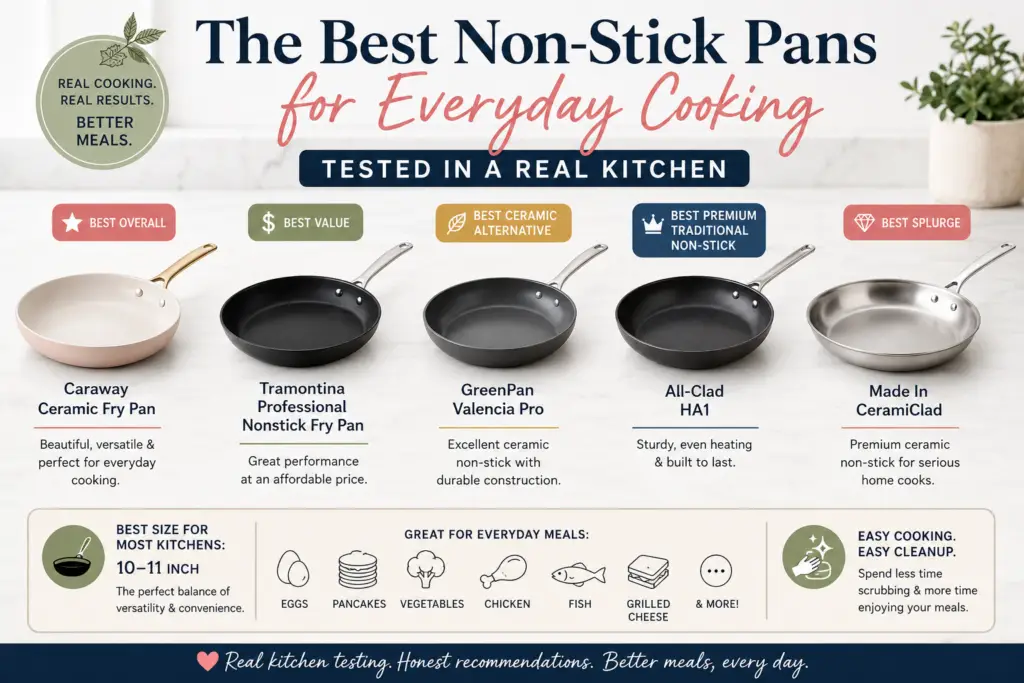
If you don’t want to read the entire guide, here are my top picks:
| Category | My Pick | Best For |
|---|---|---|
| Best Overall | Caraway Ceramic Fry Pan | Everyday home cooking (discount code applied at checkout. Tap here!) |
| Best Value | Tramontina Professional Nonstick Fry Pan | Performance on a budget |
| Best Ceramic Alternative | GreenPan Valencia Pro | Ceramic non-stick shoppers |
| Best Premium Traditional Non-Stick | All-Clad HA1 | Durability and even heating |
| Best Splurge | Made In CeramiClad | Serious home cooks |
| Best Size for Most Kitchens | 10–11-inch skillet | Everyday versatility |
If I were buying one non-stick pan for everyday cooking, I would choose a 10- to 11-inch skillet. It gives you enough room for eggs, pancakes, chicken breasts, vegetables, quesadillas and smaller one-pan meals without being unnecessarily heavy.
What I Look for in a Non-Stick Pan
I don’t think you need 15 different tests involving laboratory equipment to figure out whether a frying pan works well in a home kitchen.
I want to know what happens when dinner needs to be on the table.
For an everyday non-stick pan, these are the things that matter most to me:
Food Release
Eggs are one of my favorite tests because there is nowhere for a bad non-stick surface to hide. Scrambled eggs, fried eggs and omelets should release without leaving half of breakfast glued to the skillet.
Pancakes are another great test because you can quickly see whether a pan heats evenly.
Even Heating
A pan that burns the center of a pancake while leaving the edges pale isn’t something I want to use every morning.
The best pans distribute heat evenly enough that you aren’t constantly moving food around the skillet to compensate for hot spots.
Comfortable Weight
Heavy cookware can be wonderful for certain cooking methods, but an everyday skillet shouldn’t feel like a workout every time you move it from the stove.
There needs to be a balance between substantial construction and maneuverability.
Handle Comfort
This sounds insignificant until you’re holding a full skillet.
A comfortable, secure handle makes flipping pancakes, sautéing vegetables and transferring a pan much easier.
Cleanup
One of the biggest reasons we buy non-stick cookware is convenience.
A great non-stick pan should usually clean up with warm water, mild dish soap and a soft sponge without requiring aggressive scrubbing.
Everyday Versatility
I don’t want a pan that is useful only for eggs.
A good everyday skillet should comfortably handle:
- Eggs
- Pancakes
- French toast
- Vegetables
- Chicken
- Fish
- Quesadillas
- Grilled cheese
- Turkey burgers
- Ground meat
- Reheating leftovers
- Simple one-pan dinners
That is what earns a skillet permanent space in my kitchen.
Best Overall: Caraway Ceramic Fry Pan
Best for: Everyday cooking, eggs, vegetables, pancakes and cooks who prefer ceramic-coated cookware. Shop my favorites with a discount applied at checkout!
The Caraway Fry Pan is the pan I find easiest to recommend for someone who wants a beautiful everyday skillet without sacrificing practical cooking performance. From stovetop-to-oven, this cookware does it all!
And yes—the fact that it looks beautiful sitting on the stove doesn’t hurt.
Caraway’s fry pan uses a ceramic-coated cooking surface rather than a traditional PTFE non-stick coating. The smooth interior makes it especially useful for foods that tend to stick, including eggs, pancakes and delicate proteins.
What makes it work particularly well for my style of cooking is versatility.
I can use it for scrambled eggs in the morning, sauté vegetables for lunch and cook chicken for dinner without feeling like I’m using a specialty piece of cookware.
What I Love
- Smooth ceramic cooking surface
- Excellent release when properly cared for
- Easy cleanup
- Modern design
- Great for eggs and pancakes
- Works beautifully for vegetables and everyday proteins
- Available in several colors
- Feels substantial without feeling like restaurant equipment
What to Know
Ceramic cookware needs to be treated differently than stainless steel.
I avoid blasting it over extremely high heat unnecessarily and don’t use metal utensils on the cooking surface. Silicone and wooden utensils are my preference.
That little bit of care can go a long way toward maintaining the non-stick performance.
My Caraway Discount
Caraway cookware has become a regular part of my recipe testing and everyday cooking because I love cookware that can move from recipe development to dinner without making cleanup complicated.
If you’re shopping Caraway, you can use this link when ordering. Your generous discount is applied at checkout!
My rating: 9.5/10
Best Value: Tramontina Professional Nonstick Fry Pan
Best for: Budget-conscious cooks who want a straightforward workhorse
If your priority is performance rather than aesthetics, Tramontina Professional deserves a serious look.
This style of lightweight restaurant-inspired frying pan is exactly what many people need from non-stick cookware: inexpensive, uncomplicated and effective.
The aluminum construction heats quickly, which makes it especially useful for breakfast foods and quick weeknight cooking.
Why I Like It
- Excellent value
- Lightweight
- Quick heating
- Good food release
- Easy to maneuver
- Great dedicated egg pan
- Available in multiple sizes
If you believe non-stick cookware should be replaced when the surface eventually deteriorates rather than treated as a lifetime investment, Tramontina’s lower price makes a lot of sense.
My rating: 9/10
Best Ceramic Alternative: GreenPan Valencia Pro
Best for: Home cooks specifically looking for ceramic non-stick cookware
The GreenPan Valencia Pro is another strong choice if ceramic cookware is your priority.
GreenPan has been making ceramic non-stick cookware for years, and the Valencia Pro line combines a ceramic cooking surface with hard-anodized construction.
It feels more substantial than some lightweight ceramic pans and works especially well for foods like eggs, pancakes and fish.
What I Like
- Ceramic non-stick surface
- Excellent food release
- Sturdy construction
- Induction compatible
- Good heat distribution
- Available in several useful sizes
- Higher oven-temperature capability than many traditional non-stick pans
Potential Downside
It is heavier than some inexpensive non-stick skillets, so someone looking specifically for an ultra-light pan may prefer Tramontina.
My rating: 9/10
Best Premium Traditional Non-Stick: All-Clad HA1
Best for: Cooks who prioritize sturdy construction and even heating
All-Clad has built its reputation around serious cookware, and the HA1 Hard-Anodized Nonstick Fry Pan brings some of that substantial cookware feel into the non-stick category.
This isn’t the feather-light skillet you casually toss around with two fingers.
It feels sturdy.
The hard-anodized aluminum construction helps distribute heat evenly, while the non-stick interior makes delicate foods significantly easier to cook.
What I Like
- Very sturdy
- Excellent heat distribution
- Great for larger meals
- Good food release
- Induction-compatible construction
- Available with a lid in some sizes
What I Don’t Love
The biggest consideration is weight.
If you have trouble lifting heavier cookware or frequently toss ingredients directly in the pan, you may prefer something lighter.
My rating: 8.8/10
Best Splurge: Made In CeramiClad Frying Pan
Best for: Serious home cooks who want premium ceramic non-stick cookware
Made In’s CeramiClad Frying Pan sits toward the premium end of this list.
The biggest difference is construction.
Rather than feeling like an inexpensive aluminum skillet with a non-stick surface added to it, CeramiClad has the more substantial feel you would expect from premium cookware.
That translates into good heat control and even cooking.
It’s an excellent pan—but I wouldn’t say everyone needs to spend this much money on non-stick cookware.
If you cook frequently and appreciate high-quality cookware, however, it becomes much easier to justify.
What I Like
- Premium construction
- Excellent heat distribution
- Ceramic non-stick surface
- Comfortable handling
- Great for eggs and delicate foods
- Attractive enough to leave on the stove
The Downside
Price.
For occasional eggs and pancakes, a less expensive skillet will probably make more sense.
My rating: 8.8/10
Ceramic vs. Traditional Non-Stick: Which Is Better?
This is probably the biggest decision you’ll make when shopping for a new pan.
Ceramic Non-Stick
Ceramic-coated cookware has become extremely popular with home cooks looking for an alternative to traditional PTFE-based non-stick cookware.
Advantages include:
- Excellent initial food release
- Easy cleanup
- Often marketed as PFAS-free
- Attractive colors and designs
- Great for eggs and pancakes
The trade-off is that ceramic surfaces still require proper care.
Traditional Non-Stick
Traditional non-stick pans typically use a PTFE-based coating.
Advantages include:
- Extremely slippery cooking surface
- Excellent egg release
- Often inexpensive
- Widely available
- Great for low-fat cooking
However, these pans should generally be used according to the manufacturer’s temperature recommendations and replaced once the cooking surface becomes significantly scratched, damaged or begins deteriorating.
Is Ceramic Cookware Really Non-Stick?
Yes – but there is an important catch.
Ceramic-coated pans can be wonderfully non-stick when new and when properly maintained.
The biggest mistake I see is treating ceramic cookware exactly like stainless steel.
High heat, abrasive cleaners and metal utensils can shorten the useful life of the cooking surface.
For everyday cooking, low to medium heat is usually all you need.
What Size Non-Stick Pan Should You Buy?
If you are buying only one, I recommend approximately 10 to 11 inches.
8-Inch Pan
Best for:
- One or two eggs
- Small omelets
- Single servings
- Toasting nuts
10- to 11-Inch Pan
Best for:
- Everyday cooking
- Eggs
- Pancakes
- Chicken
- Fish
- Vegetables
- Grilled sandwiches
- Two-person meals
This is the sweet spot for most households.
12-Inch Pan
Best for:
- Families
- Multiple chicken breasts
- Large batches of vegetables
- One-pan dinners
- Four or more servings
If you cook for a family regularly, I would strongly consider the 12-inch size.
What Is the Best Non-Stick Pan for Eggs?
For eggs, I prefer ceramic.
A good ceramic skillet requires very little fat to keep scrambled or fried eggs from sticking.
Caraway and GreenPan are both particularly well suited for this.
If you cook eggs almost every morning, there’s also an argument for keeping a smaller 8-inch non-stick pan specifically for breakfast.
What Is the Best Non-Stick Pan for Pancakes?
Look for even heat distribution.
A slick cooking surface doesn’t matter much if the center of your pancake burns before the outside cooks.
Caraway, GreenPan Valencia Pro and Made In CeramiClad all perform particularly well for the kind of controlled, moderate-temperature cooking pancakes require.
What Is the Best Non-Stick Pan for Chicken?
This depends on the chicken.
For lightly sautéed chicken breasts, chicken cutlets and diced chicken, a sturdy non-stick skillet works beautifully.
If I want an extremely hard restaurant-style sear, however, I generally reach for stainless steel instead.
That’s an important point:
Non-stick cookware doesn’t need to replace every pan in your kitchen.
Different cookware materials are good at different jobs.
Non-Stick vs. Stainless Steel
I keep both.
Non-stick is better for:
- Eggs
- Pancakes
- Crepes
- Delicate fish
- Sticky sauces
- Quick breakfasts
- Low-fat cooking
Stainless steel is better for:
- High-heat searing
- Browning meat
- Developing fond
- Pan sauces
- High-temperature cooking
You don’t have to choose one team.
A well-equipped home kitchen can benefit from both.
How to Make a Non-Stick Pan Last Longer
Even an expensive pan can deteriorate quickly if it’s mistreated.
These habits make a huge difference:
- Avoid Excessively High Heat
Medium heat is enough for most non-stick cooking.
- Use Silicone or Wooden Utensils
Even when a manufacturer says metal utensils are permitted, I still prefer silicone or wood.
Why risk scratching the surface?
- Let the Pan Cool Before Washing
Putting a screaming-hot skillet directly under cold water can subject cookware to unnecessary thermal shock.
- Skip Abrasive Scrubbers
A soft sponge and dish soap should handle most cleanup.
- Don’t Stack Pans Directly Together
If you stack cookware, place a pan protector or soft towel between each piece.
- Don’t Use Cooking Spray Constantly
Some aerosol sprays can leave behind residue that becomes increasingly difficult to remove.
A little olive oil, avocado oil or butter usually works better.
When Should You Replace a Non-Stick Pan?
Non-stick cookware isn’t necessarily lifetime cookware.
Consider replacing yours when:
- The coating is peeling
- The surface is deeply scratched
- Food suddenly sticks despite proper cooking technique
- The coating appears significantly worn
- The pan has warped
- The cooking surface has been damaged
Don’t keep using a badly damaged pan simply because it was expensive.
Do Expensive Non-Stick Pans Last Longer?
Sometimes – but not always enough to justify the difference.
A $120 pan isn’t automatically going to last four times longer than a $30 pan.
What you’re often paying for is better construction, more even heating, induction compatibility, handle design, aesthetics and overall cooking experience.
That is why Tramontina remains such an appealing value option.
Are Non-Stick Pans Dishwasher Safe?
Some manufacturers say yes.
I still hand wash mine.
It takes about a minute, and hand washing is gentler on the cooking surface.
If I spend money on cookware I love, I’m willing to give it an extra 60 seconds of care.
Best Non-Stick Pan for an Induction Stove
This is where you need to pay attention to specifications.
Plain aluminum isn’t naturally induction compatible, so an aluminum pan needs a magnetic base to work on an induction cooktop.
GreenPan Valencia Pro, Made In CeramiClad and many All-Clad HA1 models are strong options to consider for induction cooking.
Always verify the exact pan and size before purchasing because specifications can vary within product lines.
My Final Ranking
After comparing performance, construction, versatility, cleanup and value, here’s how I would rank them for most home cooks:
1. Caraway Ceramic Fry Pan – Best Overall for Everyday Home Cooking
Beautiful, versatile and extremely easy to use for the foods most of us actually cook.
2. Tramontina Professional – Best Value
No-frills performance at a price that makes sense.
3. GreenPan Valencia Pro – Best Ceramic Alternative
A durable-feeling ceramic option with excellent everyday versatility.
4. All-Clad HA1 – Best Traditional Premium Pick
Excellent construction and heating for cooks who prefer a more substantial pan.
5. Made In CeramiClad – Best Splurge
Premium performance for serious cooks willing to spend more.
Which Non-Stick Pan Would I Actually Buy?
If you came into my kitchen and asked me which pan I would buy for everyday cooking, my answer would be simple:
Caraway for ceramic everyday cooking.
Tramontina if budget matters most.
GreenPan Valencia Pro if you want another excellent ceramic option.
All-Clad if you prefer heavier, more traditional cookware construction.
And if you’re building a kitchen from scratch, don’t buy five non-stick pans.
Start with one great 10- or 11-inch skillet.
Use it.
Learn how it performs on your stove.
Then decide whether you actually need anything else.
That’s a much smarter way to build a cookware collection.
More Kitchen Guides to Read
If you’re upgrading your kitchen, you may also enjoy: