If you bake often, a good stand mixer is one of those kitchen purchases that can completely change the way you bake. Cookie dough comes together faster, buttercream gets fluffier, bread dough requires far less hands-on work, and whipping egg whites or heavy cream suddenly feels almost effortless.
But what is the best stand mixer for home bakers?
The answer isn’t automatically the most expensive mixer or even the one with the biggest motor.
The best stand mixer depends on what you bake, how often you bake, how much counter space you have, and how much you realistically want to spend.
Some home bakers need a dependable mixer for chocolate chip cookies, cakes, brownies, frosting, and the occasional loaf of bread. Others are kneading sourdough, pizza dough, bagels, and double batches several times a week.
And those two bakers probably shouldn’t buy the same machine.
After years of baking everything from cheesecakes and cookies to breads, cakes, frostings, and bakery-style desserts, I’ve learned that bigger and more powerful isn’t always better. Ease of use, bowl size, attachments, stability, and how well a mixer handles the recipes you actually make matter just as much.
This guide breaks down the best stand mixers for home bakers at different budgets, including which models make the most sense for beginners, everyday bakers, bread bakers, and serious home bakers.
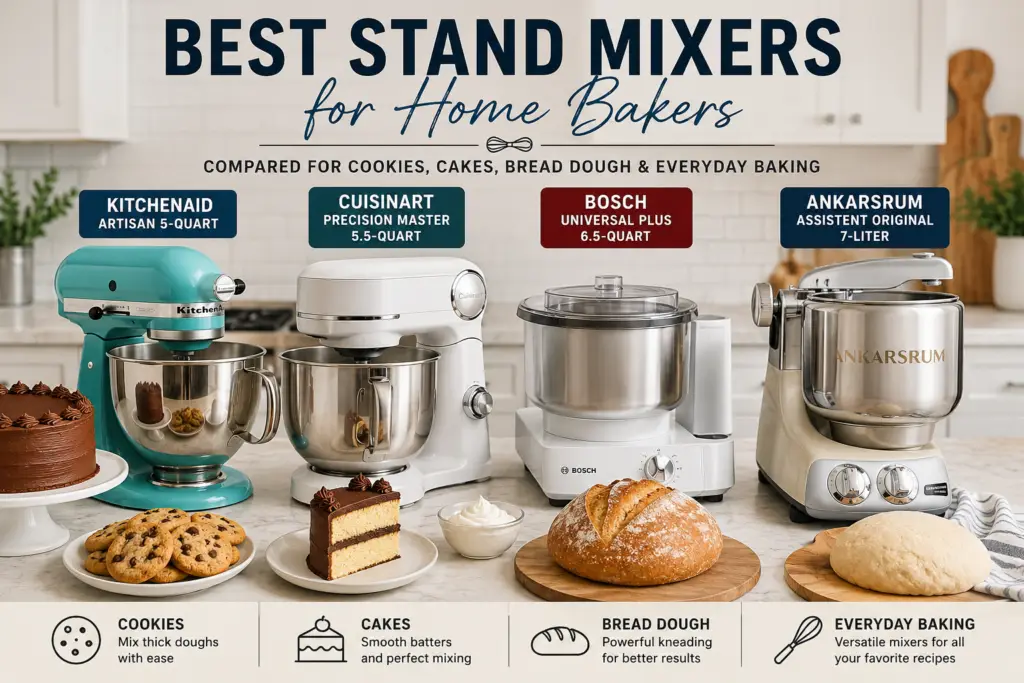
Quick Look: The Best Stand Mixers for Home Bakers
If you just want the short answer, these are the stand mixers I would put at the top of the list:
Best Overall: KitchenAid Artisan 5-Quart Tilt-Head Stand Mixer
Best Value: Cuisinart Precision Master 5.5-Quart Stand Mixer
Best for Bread Dough: Ankarsrum Assistent Original
Best Large-Batch Value: Bosch Universal Plus
Best for Most Everyday Home Bakers: KitchenAid Artisan
Best Splurge for Serious Bakers: Ankarsrum Assistent Original
The biggest takeaway?
You do not need the most expensive stand mixer to become a better baker.
For the majority of people making cookies, cakes, brownies, cheesecakes, whipped cream, frosting, and occasional yeast doughs, a dependable 5- to 5.5-quart mixer is more than enough.
My Best Overall Pick: KitchenAid Artisan 5-Quart Stand Mixer
There’s a reason the KitchenAid Artisan continues to show up in kitchens everywhere.
For the average home baker, I think it hits the sweet spot between capacity, versatility, ease of use, durability, and available attachments.
The Artisan has a 5-quart stainless-steel bowl and 10 speeds, and KitchenAid offers numerous optional attachments that use the mixer’s power hub.
That 5-quart size is particularly useful for home baking because it isn’t unnecessarily huge.
You can make:
- Cookie dough
- Cake batter
- Cheesecake filling
- Buttercream
- Whipped cream
- Meringue
- Cinnamon roll dough
- Pizza dough
- Dinner rolls
- Brownies
- Muffins
- Quick breads
without feeling like you’re using a commercial machine to make one batch of cookies.
Why I Like the KitchenAid Artisan for Home Bakers
The tilt-head design is one of its biggest advantages.
You can tilt the mixer head back, scrape the bowl, switch attachments, add ingredients, and check your dough without wrestling with a huge appliance.
It also comes with the three attachments most bakers use constantly:
Flat beater: Cookies, cakes, brownies, cheesecake filling and batters.
Wire whip: Whipped cream, meringue, egg whites and lighter mixtures.
Dough hook: Bread, pizza dough, rolls and other yeast doughs.
KitchenAid’s attachment ecosystem is another reason the Artisan remains appealing. If you want your stand mixer to do more than bake, optional attachments can expand it into tasks like pasta making and food preparation.
Where the KitchenAid Artisan Isn’t Perfect
If you’re regularly making extremely stiff bread dough or multiple large batches back-to-back, this would not necessarily be my first choice.
It’s an excellent all-purpose home baking mixer, but serious bread bakers may be happier stepping up to something designed specifically for heavy dough.
Best For
The KitchenAid Artisan is best for someone who makes a little bit of everything and wants one reliable stand mixer for everyday home baking.
Best Stand Mixer for the Money: Cuisinart Precision Master 5.5-Quart
If you want KitchenAid-like functionality but don’t necessarily want to pay KitchenAid pricing, the Cuisinart Precision Master deserves a serious look.
The Cuisinart gives you a roomy 5.5-quart bowl, 500-watt motor and 12 speeds.
That’s an impressive set of specifications for its price category.
You also get the essential baking attachments:
- Chef’s whisk
- Flat mixing paddle
- Dough hook
For cookies, cakes, brownies, muffins, frosting and everyday doughs, that’s everything most home bakers actually need.
Why It’s Such a Good Value
One thing I always recommend considering with kitchen appliances is whether you’re paying for features you’ll actually use.
If you’re primarily interested in mixing and baking – not collecting a huge attachment system – the Cuisinart can make a lot of sense.
Its 5.5-quart bowl is slightly larger than the classic 5-quart KitchenAid Artisan, and the 12 speeds give you plenty of control.
The Trade-Off
KitchenAid has the advantage when it comes to its massive accessory ecosystem and long-established popularity among home bakers.
But if your priority is simply:
Mix. Whip. Knead. Bake.
Cuisinart is one of the most compelling alternatives.
Best For
Budget-conscious home bakers who still want a substantial, versatile stand mixer.
Best Stand Mixer for Bread Dough: Ankarsrum Assistent Original
This is where things get interesting.
If your idea of baking is:
Sourdough every weekend.
Pizza dough every Friday.
Homemade bagels.
Brioche.
Cinnamon rolls.
Dinner rolls.
Sandwich bread.
Then I’d seriously consider moving away from the traditional planetary stand-mixer design.
The Ankarsrum Assistent Original is a completely different type of machine.
Instead of the attachment moving around a stationary bowl like a traditional stand mixer, the Ankarsrum uses a rotating bowl with a roller-and-scraper system.
And bread dough is where this design really shines.
The Ankarsrum has a large 7-liter stainless-steel bowl, and the manufacturer states it can handle up to 5 kilograms of dough. It also includes a dough roller, dough knife, dough hook, scraper and proofing lid, along with separate equipment for whipping and beating.
Why Bread Bakers Love It
Heavy dough puts a completely different kind of stress on a mixer than cake batter.
That’s why I don’t recommend choosing a mixer based on wattage alone.
You need to consider:
- Torque
- Bowl design
- Dough capacity
- Stability
- Heat buildup
- How efficiently the machine actually kneads
The Ankarsrum’s design is particularly well suited to large and heavy bread doughs.
It’s also backed by a seven-year warranty according to Ankarsrum.
The Downside
There’s a learning curve.
If you’ve spent years using a traditional tilt-head mixer, the Ankarsrum looks and behaves differently.
It’s also expensive.
At roughly the premium end of the home-mixer market, this isn’t something I would tell a casual baker to buy just because it’s powerful.
If you make cupcakes twice a year, save your money.
If you’re feeding a sourdough starter like it’s another member of your family, however, this mixer starts making a lot more sense.
Best For
Serious bread bakers, sourdough bakers and anyone regularly making large batches of yeast dough.
Best Large-Batch Mixer: Bosch Universal Plus
The Bosch Universal Plus is another machine that deserves more attention from serious home bakers.
Its design is very different from the classic KitchenAid-style mixer, with the motor positioned beneath the bowl rather than in a large mixer head.
Current versions are available with a large bowl, including 6.5-quart configurations, making this an interesting choice for larger batches.
What I like most about this category of mixer is that it’s designed for people who aren’t just making one dozen cookies.
Think:
- Multiple loaves of bread
- Large batches of pizza dough
- Holiday baking
- Big cookie batches
- Cinnamon rolls for a crowd
- Meal-prep baking
- Large families
If capacity matters more to you than having a pretty tilt-head mixer sitting on the counter, the Bosch deserves consideration.
Best For
High-volume home bakers who regularly double or triple recipes.
KitchenAid vs. Cuisinart: Which Is Better?
This is probably one of the biggest questions home bakers have.
And my answer is:
KitchenAid is the better ecosystem. Cuisinart may be the better value.
The KitchenAid Artisan gives you:
- 5-quart capacity
- 10 speeds
- Tilt-head design
- Huge attachment ecosystem
- Tons of color options
- Easy-to-find bowls and accessories
- Familiar controls
The Cuisinart Precision Master gives you:
- 5.5-quart capacity
- 12 speeds
- 500-watt motor
- Tilt-back head
- Essential baking attachments
- Usually a lower entry price
For someone building a kitchen and expecting to use the mixer for years for all sorts of tasks, I’d lean KitchenAid.
For someone thinking, “I just want a really good mixer without spending more than necessary,” I’d look closely at Cuisinart.
KitchenAid vs. Ankarsrum: Which Should You Buy?
These mixers are really designed for different bakers.
If you primarily make:
- Cookies
- Cakes
- Cheesecake
- Frosting
- Brownies
- Cupcakes
- Whipped cream
- Occasional bread
Choose KitchenAid.
If you primarily make:
- Sourdough
- Bagels
- Pizza dough
- Brioche
- Sandwich bread
- Large batches of yeast dough
Consider Ankarsrum.
The KitchenAid is more intuitive for the average home baker.
The Ankarsrum becomes increasingly attractive as bread makes up a larger percentage of what you bake.
How Much Should You Spend on a Stand Mixer?
This is where I think shoppers sometimes get carried away.
You don’t automatically need an $800 mixer.
Under $150
Budget stand mixers can absolutely handle basic cake batters, whipped cream, frosting and lighter cookie dough.
The problem tends to show up when you ask them to repeatedly knead stiff dough.
If you’re an occasional baker, this price range may be enough.
If you bake weekly, I’d consider investing more.
$200–$350
This is one of the best price ranges for value.
You’re starting to see sturdier machines, better bowls, better controls and motors capable of handling a broader range of recipes.
This is where sale pricing on models like the Cuisinart Precision Master can become particularly attractive.
$350–$550
This is the sweet spot for serious everyday home baking.
You’re getting into machines that can realistically become long-term kitchen appliances instead of something you replace after a few years.
The KitchenAid Artisan frequently falls into this general category depending on color, package and retailer.
$600+
At this point, I think you need a reason to spend the money.
Large-volume baking?
Frequent bread making?
Heavy dough?
Specialized performance?
Then absolutely.
But don’t buy an expensive mixer simply because it’s labeled “professional.”
Buy the mixer that fits the way you actually bake.
What Size Stand Mixer Is Best for Home Baking?
For most households, I recommend approximately 5 to 6 quarts.
That range gives you enough room for most standard recipes without creating problems when you’re trying to whip a smaller quantity.
4–5 Quarts
Great for:
- Small households
- Cookies
- Cakes
- Frosting
- Brownies
- Occasional bread
5–6 Quarts
My favorite range for most home bakers.
Great for:
- Standard recipes
- Double batches
- Bread dough
- Cakes
- Cookies
- Cheesecake
- Holiday baking
6+ Quarts
Better for:
- Large families
- Frequent bread baking
- Double and triple batches
- Holiday baking
- Home baking businesses
Bigger isn’t automatically better.
If you’re constantly making small recipes in an enormous bowl, you may actually find a smaller mixer more convenient.
Tilt-Head vs. Bowl-Lift Stand Mixers
Tilt-Head Mixer
The mixer head tilts backward so you can access the bowl.
I generally prefer this design for everyday home baking because it’s simple and convenient.
Great for:
- Cookies
- Cakes
- Cheesecake
- Frosting
- Muffins
- Brownies
- Everyday baking
Bowl-Lift Mixer
Instead of tilting the head, you raise and lower the bowl.
These mixers tend to be larger and can provide additional stability for heavier recipes.
They’re worth considering if you frequently make bread or large batches.
How Powerful Should a Stand Mixer Be?
Don’t shop by wattage alone.
This is probably one of the biggest mistakes people make when comparing mixers online.
A mixer advertising a huge wattage number isn’t automatically better than one with a smaller number.
Motor design, gearing, torque, bowl shape and how efficiently that power reaches the dough all matter.
Instead of asking:
“Which mixer has the most watts?”
Ask:
“Which mixer performs best for what I bake?”
That’s a much more useful comparison.
Best Stand Mixer for Cookies
For cookie bakers, my pick is the KitchenAid Artisan 5-Quart.
Cookie dough doesn’t necessarily require the same sustained kneading performance as bread, but it can become thick – especially once you add chocolate chips, nuts, oats or candy pieces.
A 5-quart bowl is also large enough for generous batches without becoming cumbersome for everyday recipes.
Best Stand Mixer for Cakes
Again, I’d choose the KitchenAid Artisan or Cuisinart Precision Master.
Cake batter doesn’t require extreme power.
What matters more is:
- Consistent mixing
- Good speed control
- Easy bowl access
- Effective scraping
- Reliable whipping
You don’t need a commercial-style mixer to make a beautiful layer cake.
Best Stand Mixer for Cheesecake
As someone who makes a lot of cheesecake, this is one place where I think technique matters more than raw mixer power.
You want to mix cheesecake filling until smooth without unnecessarily whipping huge amounts of air into it.
A stand mixer with good low-speed control is extremely useful.
The KitchenAid Artisan works beautifully for this type of baking because you can easily stop, scrape down the bowl and continue mixing.
Baker’s Tip: Once you add the eggs to cheesecake batter, keep your mixer speed low and mix only until incorporated. Too much air can contribute to excessive rising and cracking during baking.
Best Stand Mixer for Beginners
I wouldn’t tell a beginner to automatically buy the cheapest mixer.
If you’re already excited about baking and expect to continue, buying something you’ll outgrow in six months isn’t necessarily saving money.
For a beginner who expects to bake regularly, my two starting points would be:
- KitchenAid Artisan if the budget allows.
- Cuisinart Precision Master if value is the priority.
Both give you room to grow.
Best Stand Mixer for a Home Baking Business
This answer depends heavily on what you’re selling.
For cakes, cupcakes, frosting and cookies, a larger KitchenAid-style mixer may make sense.
For bread, bagels, cinnamon rolls or pizza dough, I’d seriously consider the Ankarsrum or Bosch.
And if production becomes truly substantial, you may eventually outgrow consumer stand mixers altogether and need commercial equipment.
What Attachments Do You Actually Need?
Ignore the giant boxes filled with accessories for a minute.
Most bakers use three attachments repeatedly:
Flat Beater
Your everyday workhorse.
Use it for cookies, cake batter, brownies, cheesecake filling and many other mixtures.
Wire Whisk
Use it for:
- Whipped cream
- Meringue
- Egg whites
- Light frostings
Dough Hook
Use it for:
- Bread
- Pizza
- Cinnamon rolls
- Dinner rolls
- Brioche
Everything beyond those is a bonus.
Stand Mixer Features Worth Paying For
When comparing mixers, these are the features I’d prioritize:
Sturdy construction: The machine shouldn’t feel like it’s trying to escape across the counter when mixing dough.
Useful bowl size: Around 5–6 quarts works beautifully for most households.
Multiple speeds: You want true low speeds as much as you want high ones.
Easy bowl access: Especially important when you’re constantly scraping batter.
Replacement parts and accessories: You’re hopefully buying an appliance you’ll keep for years.
Good dough performance: Essential if bread is part of your routine.
Warranty: Particularly important on premium mixers.
Features You Probably Don’t Need
Don’t automatically pay extra for:
- Huge digital displays
- Dozens of speeds you’ll never distinguish between
- Oversized bowls
- Giant accessory packages
- “Professional” branding
- Extremely high advertised wattage
Unless those features solve an actual problem in your kitchen, they’re just features.
My Stand Mixer Buying Rule
Here’s the easiest way I know to choose.
Think about the five things you baked most often during the last year.
Not what you hope you’ll make someday.
What did you actually bake?
If your list looks like:
- Chocolate chip cookies
- Cheesecake
- Birthday cake
- Buttercream
- Brownies
Buy a great everyday planetary mixer.
If your list looks like:
- Sourdough
- Pizza
- Bagels
- Brioche
- Cinnamon rolls
Prioritize dough performance.
That one exercise can keep you from spending hundreds of dollars on the wrong machine.
Are Expensive Stand Mixers Worth It?
Sometimes.
A premium mixer is worth the investment when you’re paying for something you’ll actually use:
- Greater dough capacity
- Better durability
- Better stability
- Specialized kneading
- Larger batches
- Longer warranty
- Better accessories
But expensive doesn’t automatically mean better for you.
A $250 mixer that perfectly handles your weekly cookie and cake recipes is a better purchase than an $800 bread-focused machine that spends 360 days a year collecting dust.
Can You Make Bread Without a Stand Mixer?
Absolutely.
People made bread long before electric mixers existed.
You can knead bread by hand, use stretch-and-fold techniques, or make no-knead bread.
A stand mixer simply makes the process easier and more consistent—especially if you’re making bread frequently.
Is KitchenAid Still the Best Stand Mixer?
For most home bakers, I still think KitchenAid is one of the safest all-around recommendations.
Recent independent testing continues to place KitchenAid Artisan models among the strongest overall choices for home bakers, while other models increasingly shine in specialized categories like bread making and value.
That’s the important distinction.
There isn’t one universal “best mixer.”
There’s a best mixer for the way you bake.
Final Verdict: Which Stand Mixer Should You Buy?
If I were helping a friend choose today, here’s how I’d narrow it down.
- Buy the KitchenAid Artisan 5-Quart if:
You bake a little bit of everything and want the best all-around choice. - Buy the Cuisinart Precision Master if:
You want excellent everyday functionality while keeping the budget lower. - Buy the Ankarsrum Assistent Original if:
Bread, sourdough, pizza and heavy dough are the heart of your baking routine. - Buy the Bosch Universal Plus if:
You make big batches and want capacity and dough performance.
For the average home baker, though, the KitchenAid Artisan 5-Quart remains my best overall pick because its size, controls, attachments and versatility make sense for the widest variety of recipes.
And if you’re trying to get the most mixer for your money, the Cuisinart is the model I’d watch for a good sale.
For serious bread bakers who need more capacity, the Bosch is another strong contender.