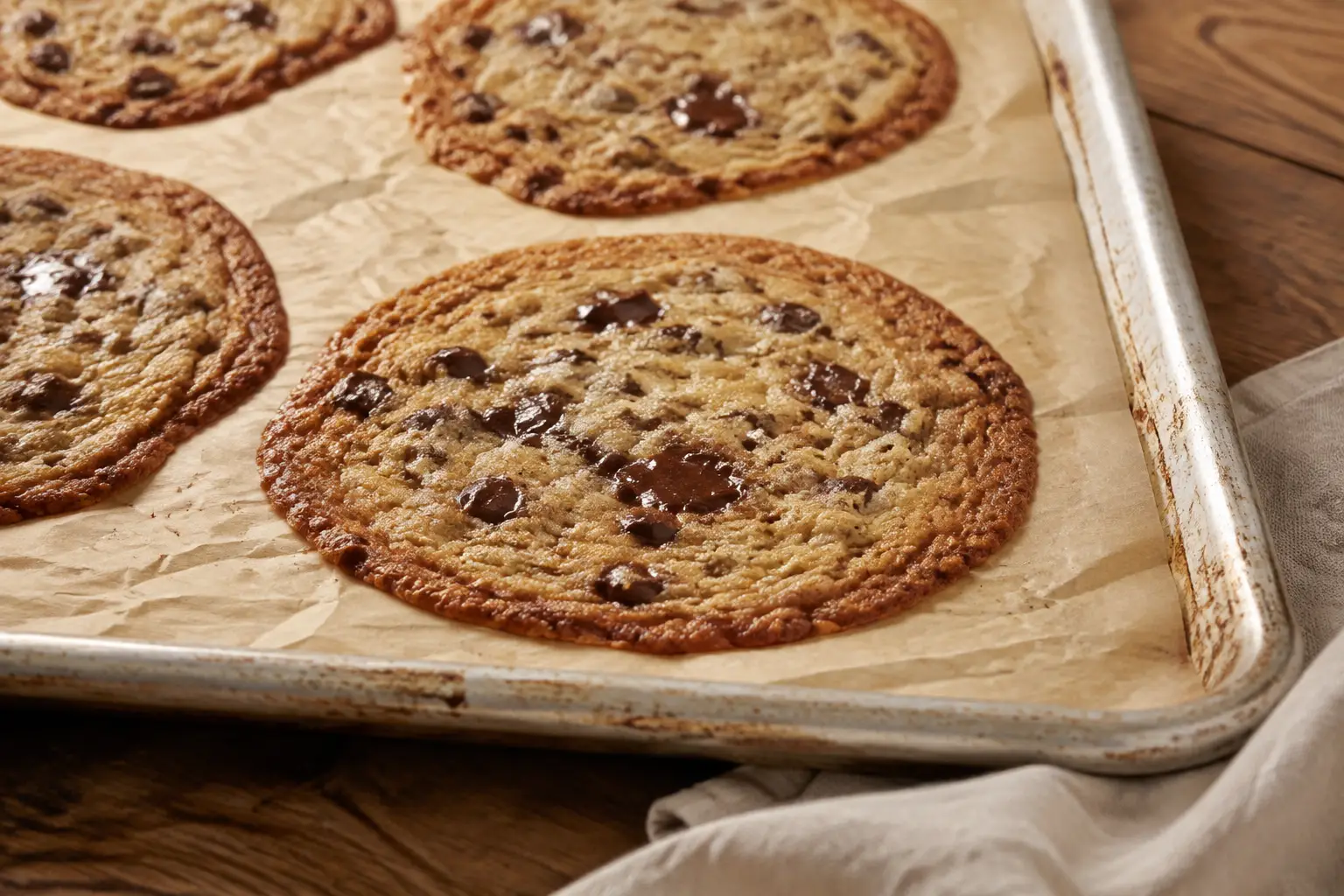
You followed the recipe, watched the oven timer, and expected a batch of thick, chewy cookies. Instead, your cookie dough spread across the baking sheet and turned into thin, crispy puddles.
So, why are your cookies flat?
Cookies usually spread too much because the butter was too warm, the dough needed more flour, the baking sheet was hot, or the oven temperature was lower than expected. Small changes in ingredient temperature, measuring, and baking technique can completely change the shape and texture of a cookie.
The good news is that flat cookies are usually easy to prevent. Once you know what caused the problem, you can adjust your dough or baking method and get thicker cookies with soft centers and golden edges.
Quick Answer: Why Did My Cookies Go Flat?
The seven most common causes of flat cookies are:
- The butter was too warm or melted.
- The dough did not have enough flour.
- The cookie dough was not chilled.
- The baking sheet was warm or greased.
- The oven temperature was too low.
- The leavening agent was old or measured incorrectly.
- The sugar and butter ratio was off.
If your cookies are already in the oven and spreading too quickly, take the baking sheet out, gently push the edges inward with a spoon, and chill the remaining dough before baking another batch.
How Cookie Spread Works
Cookie dough begins to spread as the butter melts in the oven. At the same time, flour, eggs, and leavening agents help the dough set.
The goal is for the cookie to spread just enough before its structure becomes firm. If the fat melts before the dough has time to set, the cookies continue spreading and turn out thin.
That balance can be affected by:
- Butter temperature
- Flour measurement
- Type of sugar
- Dough temperature
- Baking sheet temperature
- Oven accuracy
- Leavening agents
This is why two batches made from the same recipe can look different if the dough or baking conditions change.
1. Your Butter Was Too Warm or Melted
Warm butter is one of the most common reasons cookies spread too much.
Many recipes call for softened butter, but softened does not mean partially melted. Butter that is greasy, shiny, or beginning to pool around the edges is too warm.
Properly softened butter should give slightly when pressed with a finger, but it should still hold its shape. It should not feel oily.
When overly warm butter enters the oven, it melts before the flour and eggs can give the cookies enough structure. The dough quickly spreads across the pan.
How to Fix It
If you have already mixed the dough, refrigerate it for at least 30 to 60 minutes. Very soft dough may need closer to two hours.
For your next batch:
- Let cold butter sit at room temperature for about 30 to 60 minutes.
- Cut the butter into small pieces to help it soften evenly.
- Avoid microwaving butter unless the recipe calls for melted butter.
- If using the microwave, heat it for only a few seconds at a time.
The exact softening time will depend on the temperature of your kitchen.
How to Tell If Butter Is Properly Softened
Press the butter gently with your finger. It should leave a shallow indentation without sinking straight through.
If the butter collapses, looks glossy, or leaves grease on your finger, place it in the refrigerator for 10 to 15 minutes before using it.
2. You Did Not Add Enough Flour
Flour gives cookie dough its structure. Without enough flour, the dough cannot hold its shape once the butter begins to melt.
This often happens when flour is measured by scooping it directly from the bag with a measuring cup. Depending on how the flour settles, you may end up with more or less than the recipe intended.
It can also happen when a recipe was written using grams, but the ingredients were converted to cups incorrectly.
How to Fix It
The most accurate way to measure flour is with a kitchen scale.
One cup of all-purpose flour usually weighs about 120 to 125 grams, although recipe writers may use slightly different standards. If the recipe includes gram measurements, use those measurements.
If you are using measuring cups:
- Stir the flour gently in its container.
- Spoon it into the measuring cup.
- Let the flour pile slightly above the rim.
- Level it with the back of a knife.
Do not shake, tap, or pack the measuring cup.
Can You Add More Flour to Cookie Dough?
Yes, but add it slowly.
If you bake one test cookie and it spreads into a very thin circle, mix one tablespoon of flour into the remaining dough. Bake another test cookie before adding more.
Too much flour can make cookies dry, dense, or cakey, so avoid adding a large amount all at once.
3. You Did Not Chill the Cookie Dough
Chilling cookie dough gives the butter time to firm up. Cold butter takes longer to melt, which helps the cookies hold their shape during the first few minutes of baking.
Resting the dough can also give the flour time to absorb moisture. This often produces thicker cookies with a chewier texture and deeper flavor.
Not every recipe requires chilling, but it is especially helpful when:
- The kitchen is warm.
- The dough feels sticky.
- The recipe uses a large amount of butter.
- The butter became too soft during mixing.
- You want thick, bakery-style cookies.
- The first test cookie spread too much.
How to Fix It
Cover the cookie dough and refrigerate it for at least 30 minutes. For very soft dough, chill it for one to two hours.
You can chill the dough in the mixing bowl or portion it into balls first. Scooping before chilling is usually easier because cold dough can become firm and difficult to portion.
If the chilled dough is too hard, let it sit at room temperature for about 10 minutes before baking.
Does Chilling Cookie Dough Stop Spreading?
Chilling slows the spread, but it will not correct every recipe issue. Dough that contains far too little flour or too much butter may still spread after chilling.
Bake one test cookie before placing an entire batch in the oven. It is a simple way to see whether the dough is ready.
4. Your Baking Sheet Was Warm or Greased
Placing cookie dough on a warm baking sheet starts softening the butter before the cookies enter the oven.
This often happens when several batches are baked using the same pan. Even if the pan no longer feels extremely hot, it may still be warm enough to affect the dough.
Greasing the baking sheet can also make cookies spread. Most cookie recipes already contain plenty of fat, so adding cooking spray or butter to the pan creates an extra slippery surface.
How to Fix It
Allow the baking sheet to cool completely between batches.
For faster cooling:
- Use two or more baking sheets and rotate them.
- Run the bottom of the empty pan under cool water, then dry it completely.
- Place the pan on a cooling rack.
- Avoid placing a warm pan directly in the refrigerator.
Line the cooled baking sheet with parchment paper or a silicone baking mat if the recipe calls for one. Do not grease the parchment.
Parchment Paper vs. Silicone Baking Mats
Both can work, but they do not always produce identical results.
Silicone baking mats may cause some cookie recipes to spread slightly more because the surface holds heat differently. If your cookies keep spreading, try parchment paper on a light-colored metal baking sheet.
Avoid baking cookies directly on a heavily greased pan unless the recipe specifically tells you to do so.
5. Your Oven Temperature Was Too Low
If the oven is not hot enough, the butter melts before the cookie has time to set. This produces thin cookies with wide, sometimes greasy edges.
Your oven may say it has reached 350°F, but the actual temperature could be lower. Home ovens commonly run hotter or cooler than the displayed setting.
The temperature may also drop if the oven door is opened often or the dough is placed inside before preheating is complete.
How to Fix It
Use an inexpensive oven thermometer to check the actual temperature.
Place the thermometer near the center of the oven and let the oven preheat for at least 15 to 20 minutes after it signals that it is ready. Some ovens beep before the entire oven has fully heated.
If the thermometer shows that your oven runs 20°F too cool, increase the set temperature to account for the difference.
You can also have the oven recalibrated if the temperature is consistently inaccurate.
What Temperature Is Best for Baking Cookies?
Most cookies bake well at 350°F, but some thick cookies are baked at 375°F to help the edges set sooner.
Always begin with the temperature listed in the recipe. If your cookies repeatedly spread and you know the measurements are correct, try increasing the temperature by 10°F to 15°F.
Do not raise it too much. A very hot oven can burn the outside while leaving the center raw.
6. Your Baking Soda or Baking Powder Was Old or Incorrectly Measured
Baking soda and baking powder affect how cookies rise, spread, and brown.
Baking soda encourages spreading and browning. Baking powder usually creates a puffier, softer result. They are not interchangeable in equal amounts.
Using too much baking soda can make cookies spread excessively. Old leavening may fail to give the dough the lift it needs.
How to Fix It
Check the expiration date on the container and replace leavening agents that have been open for a long time.
Measure them with proper measuring spoons and level the top. Do not estimate or use a regular kitchen spoon.
To test baking powder:
- Add about 1/2 teaspoon of baking powder to a small bowl.
- Pour in a little hot water.
- Look for immediate bubbling.
To test baking soda:
- Add about 1/2 teaspoon of baking soda to a small bowl.
- Pour in a splash of vinegar or lemon juice.
- Look for immediate fizzing.
If there is little or no reaction, replace it.
Can You Substitute Baking Powder for Baking Soda?
Not without changing the recipe.
Baking soda needs an acidic ingredient, such as brown sugar, molasses, lemon juice, or natural cocoa powder, to work properly. Baking powder already contains the acid it needs.
Substituting one for the other can change the spread, color, flavor, and texture of the cookies. Use the ingredient listed in the recipe whenever possible.
7. The Sugar and Butter Ratio Was Off
Sugar does more than make cookies sweet. It also affects moisture, browning, crispness, and spread.
Granulated sugar usually produces more spread and crisper edges. Brown sugar holds more moisture and often creates a thicker, chewier cookie.
Too much sugar or butter can cause cookies to spread across the baking sheet. This can happen when ingredients are measured incorrectly or when a substitution changes the recipe’s balance.
For example, replacing brown sugar with the same amount of granulated sugar may produce a thinner cookie. Adding extra butter for a richer flavor can also make the dough too loose.
How to Fix It
Follow the recipe measurements closely, especially the first time you make it.
Do not reduce the flour, increase the butter, or swap the sugars unless you are prepared for the texture to change.
If the dough appears greasy or unusually loose:
- Chill it for at least one hour.
- Bake one test cookie.
- Add one tablespoon of flour if it still spreads too much.
- Repeat only if needed.
If you accidentally added too much sugar or butter, you may need to increase the other ingredients proportionally. Guessing can be difficult, so doubling the remaining ingredients may be easier if you know exactly how much extra was added.
Quick Cookie Troubleshooting Chart
| What the cookies look like | Likely cause | What to do |
|---|---|---|
| Very thin with greasy edges | Butter was too warm | Chill the dough for 30 to 60 minutes |
| Thin and crisp across the entire cookie | Not enough flour | Add flour one tablespoon at a time |
| First batch looks good, later batches spread | Baking sheet was warm | Cool the pan completely |
| Pale, flat, and slow to bake | Oven temperature was too low | Check the oven with a thermometer |
| Flat with a bitter or soapy taste | Too much baking soda | Measure carefully and check the recipe |
| Wide with crisp edges | Too much granulated sugar | Check the sugar measurement |
| Dough spreads before entering the oven | Dough or kitchen is too warm | Refrigerate the portioned dough |
| Cookies bake unevenly | Dark, thin, or warped baking sheet | Use a light-colored metal baking sheet |
How to Stop Cookies From Spreading While They Bake
If you notice your cookies spreading too quickly, you may still be able to save the batch.
Remove the baking sheet from the oven and use a spoon or round cookie cutter to gently push the edges toward the center. Return the pan to the oven and finish baking.
For the remaining dough:
- Place it in the refrigerator for 30 to 60 minutes.
- Make sure the baking sheet is completely cool.
- Line the pan with parchment paper.
- Bake one test cookie.
- Add one tablespoon of flour if the test cookie still spreads too much.
A test cookie saves time and prevents an entire tray from turning into one large cookie.
Can You Fix Flat Cookies After Baking?
You cannot make fully baked cookies thicker, but you can improve their appearance while they are still warm.
Place a round cookie cutter or drinking glass around each cookie and move it in a gentle circular motion. This shapes uneven edges and makes the cookies look rounder.
Flat cookies can also be repurposed. Try using them for:
- Ice cream sandwiches
- Cookie crumbs for pie crust
- Cheesecake toppings
- Ice cream mix-ins
- Cookie truffles
- Layered pudding desserts
They may not look the way you planned, but they can still taste great.
Why Did Only Some of My Cookies Spread?
Uneven spreading usually points to inconsistent dough temperature, cookie size, or pan placement.
A few things may have happened:
- Some dough balls sat near a warm oven.
- The baking sheet had warm spots.
- The cookies were not portioned evenly.
- One section of the oven runs hotter than another.
- The dough was not mixed evenly.
- Some portions contained more chocolate chips or mix-ins.
Use a cookie scoop to keep each portion close to the same size. Rotate the baking sheet once during baking if your oven has noticeable hot spots.
Avoid overloading the pan. Leave at least two inches between standard cookie dough balls so heat can circulate around them.
Does the Type of Baking Sheet Matter?
Yes. The color, material, and condition of the baking sheet can affect the way cookies bake.
Light-colored aluminum baking sheets usually provide the most even results. Dark pans absorb more heat and can make the bottoms brown before the centers finish baking.
Insulated baking sheets may slow browning and sometimes allow cookies to spread more before setting. Very thin pans can heat unevenly and warp in the oven.
For consistent results, use a sturdy, light-colored metal baking sheet lined with parchment paper.
Should You Flatten Cookie Dough Before Baking?
It depends on the recipe.
Some thick cookie doughs need to be pressed slightly so the centers bake evenly. Softer doughs usually spread on their own and should not be flattened.
If a recipe tells you to roll the dough into balls without pressing them, leave them alone. Flattening a dough that already contains warm butter may produce very thin cookies.
For thick bakery-style cookies, shape the dough balls so they are slightly taller than they are wide. This can help keep the centers thick as the cookies spread.
How Mixing Affects Cookie Spread
Mixing butter and sugar adds air to the dough. This process is called creaming.
If you barely mix them, the cookies may be dense. If you mix them for too long, the butter can become warm and the dough may spread more than expected.
Cream softened butter and sugar until the mixture looks lighter and fluffy, usually about two to three minutes with an electric mixer. Stop occasionally and scrape down the bowl.
After adding flour, mix only until the dry streaks disappear. Overmixing flour can produce tougher cookies.
Do Eggs Make Cookies Spread?
Eggs affect moisture, structure, and texture.
Egg whites help cookies set, while egg yolks add fat and tenderness. An extra egg yolk can produce a softer, chewier cookie, but adding a whole extra egg may make the dough too wet.
Egg size also matters. Most American cookie recipes are written for large eggs. Using extra-large or jumbo eggs can add more liquid than the recipe needs.
Use the egg size listed in the recipe and avoid adding an extra egg unless the recipe has been tested that way.
High Altitude and Flat Cookies
At higher elevations, lower air pressure can cause cookies to spread or bake differently. You may need to adjust the flour, sugar, liquid, or oven temperature.
Start with small changes:
- Add one to two tablespoons of flour.
- Reduce the sugar by one tablespoon.
- Increase the oven temperature by 15°F to 25°F.
- Shorten the baking time slightly.
- Chill the dough before baking.
Make one adjustment at a time so you can see which change helps.
How to Get Thick, Soft Cookies Every Time
Use this checklist before your next batch:
- Measure flour with a scale when possible.
- Use softened butter that is still cool.
- Do not substitute melted butter for softened butter.
- Chill sticky or loose dough.
- Scoop evenly sized portions.
- Place dough on a cool baking sheet.
- Use parchment paper instead of grease.
- Preheat the oven fully.
- Check the oven temperature with a thermometer.
- Use fresh baking soda or baking powder.
- Bake one test cookie first.
- Let cookies cool on the baking sheet for a few minutes.
Last Thoughts
Flat cookies usually come down to temperature, measurements, or ingredient balance. Start by checking the butter, flour, chilled dough, baking sheet, and oven temperature. Those five areas account for most spreading problems.
When you are unsure, bake one test cookie. It gives you a chance to chill the dough, add a small amount of flour, or adjust the oven before baking the rest of the batch.
With a cool pan, properly softened butter, accurately measured flour, and a fully heated oven, you should be well on your way to thicker cookies with chewy centers and lightly crisp edges.