If you have ever been halfway through making cookies only to realize you are out of brown sugar—or wondered whether you can swap white sugar for brown sugar—you are definitely not alone. Brown sugar vs. white sugar in baking might seem like a small ingredient choice, but it can completely change the texture, flavor, color, and even spread of your baked goods.
Both sugars make things sweet, obviously. But they don’t behave exactly the same once they hit butter, flour, eggs, and a hot oven.
The biggest difference? Brown sugar contains molasses, while regular white granulated sugar does not. That little bit of molasses brings moisture, acidity, deeper flavor, and a softer texture to baked goods.
So which sugar should you use for cookies? What happens if you use brown sugar instead of white sugar in a cake? And can you substitute one for the other?
Let’s break it down.
Brown Sugar vs. White Sugar: The Quick Answer
If you only remember one thing, make it this:
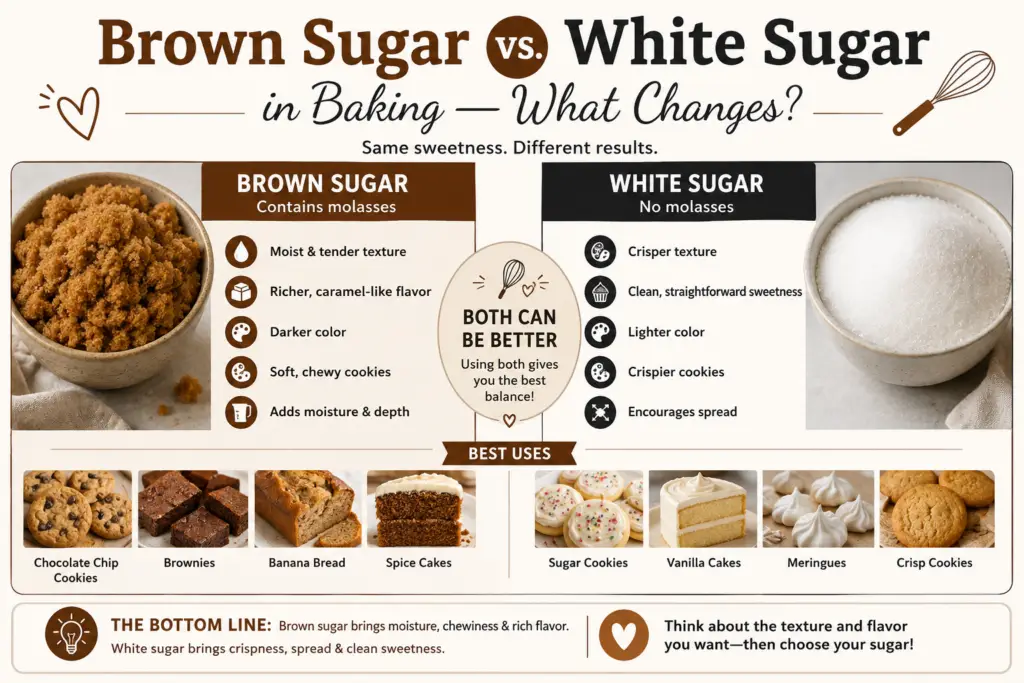
White sugar generally makes baked goods lighter, crisper, and sometimes more spread out. Brown sugar generally makes them softer, chewier, moister, darker, and more caramel-like in flavor.
Neither one is automatically “better.”
It depends entirely on what you are baking—and what texture you want.
Here is the quick comparison:
| Baking Result | White Sugar | Brown Sugar |
|---|---|---|
| Sweetness | Clean, straightforward | Richer, caramel-like |
| Moisture | Lower | Higher |
| Cookies | Crispier | Softer and chewier |
| Color | Lighter | Darker |
| Flavor | Neutral sweetness | Molasses/caramel notes |
| Texture | Light/crisp | Soft/moist |
| Spread | Often encourages spread | Can create thicker, chewier results |
| Best For | Sugar cookies, meringues, crisp cookies | Chocolate chip cookies, brownies, spice cakes |
And sometimes?
The best answer is to use both.
What Is White Sugar?
White sugar, also called granulated sugar, is the standard sugar most of us keep in the pantry.
It has a clean sweetness and relatively dry texture. Because it doesn’t contain the added molasses found in brown sugar, it doesn’t bring much additional moisture or flavor to a recipe.
That neutrality is actually one of its biggest advantages.
White sugar lets ingredients like vanilla, lemon, almond, chocolate, and fruit shine without introducing a noticeable molasses flavor.
It is commonly used in:
- Sugar cookies
- Shortbread-style cookies
- Vanilla cakes
- Cupcakes
- Meringues
- Cheesecakes
- Muffins
- Quick breads
- Pie fillings
White sugar is also particularly useful when you want a lighter-colored finished bake.
What Is Brown Sugar?
Brown sugar is essentially granulated sugar combined with molasses.
That molasses changes much more than the color.
It adds moisture, acidity, flavor, and hygroscopic properties, meaning brown sugar is particularly good at attracting and holding onto moisture.
That is one reason cookies made with brown sugar often stay softer longer.
Brown sugar works especially well in:
- Chocolate chip cookies
- Oatmeal cookies
- Brownies
- Blondies
- Banana bread
- Pumpkin bread
- Spice cakes
- Cinnamon desserts
- Crumb toppings
- Caramel-flavored desserts
It creates that deeper, almost caramel or toffee-like sweetness that white sugar alone can’t quite replicate.
Light Brown Sugar vs. Dark Brown Sugar
You’ll usually find two types of brown sugar at the grocery store: light brown sugar and dark brown sugar.
The primary difference is the amount of molasses.
Light Brown Sugar
Light brown sugar contains less molasses, so its flavor is relatively mild.
It is my everyday choice for recipes like chocolate chip cookies, muffins, blondies, and quick breads when I want moisture and chewiness without an overpowering molasses flavor.
Dark Brown Sugar
Dark brown sugar contains more molasses.
That gives it a darker color and stronger caramel, toffee, and molasses flavor.
Dark brown sugar works beautifully in recipes where those deeper flavors are welcome, including:
- Gingerbread
- Molasses cookies
- Spice cakes
- Sticky cakes
- Pumpkin desserts
- Chocolate desserts
- Rich brownies
You can often substitute light and dark brown sugar for one another, but expect a noticeable difference in flavor and color.
Brown Sugar vs. White Sugar in Cookies
This is where the difference between the two sugars becomes really noticeable.
Bake two batches of otherwise identical cookies—one with primarily granulated sugar and one with primarily brown sugar—and they can look and taste surprisingly different.
White Sugar Makes Cookies Crispier
Granulated sugar tends to encourage a crisper texture.
It can help cookies develop thinner, crunchier edges and that classic crisp bite you want in certain recipes.
That’s why you’ll commonly see plenty of granulated sugar in recipes for sugar cookies and other crisp cookies.
Brown Sugar Makes Cookies Chewier
Brown sugar is the ingredient I reach for when I want a cookie that is:
Soft. Thick. Moist. Chewy.
The molasses adds moisture while contributing a deeper flavor.
Think about your favorite bakery-style chocolate chip cookie. That chewy center and caramel-like flavor often comes from using a generous amount of brown sugar.
Why Do Chocolate Chip Cookies Use Both Brown and White Sugar?
Because you can get some of the best characteristics of both sugars.
White sugar helps provide sweetness, spread, and crisp edges.
Brown sugar brings moisture, chewiness, and caramel flavor.
Together, you can create a cookie with crispy edges and a soft, chewy center.
This is one of those situations where the recipe isn’t using two sugars simply for sweetness. Each sugar is doing a different job.
What Happens If You Use All Brown Sugar in Cookies?
Replacing all the granulated sugar in a cookie recipe with brown sugar can create cookies that are:
- Softer
- Chewier
- Darker
- More moist
- Richer in flavor
- More caramel-like
Depending on the recipe, they may also behave differently during baking.
That isn’t necessarily a bad thing.
If your ideal chocolate chip cookie is soft and chewy rather than thin and crispy, increasing the proportion of brown sugar can be a very good experiment.
What Happens If You Use All White Sugar in Cookies?
Going in the opposite direction changes things too.
Cookies made predominantly with granulated sugar are generally more likely to have a:
- Crisper texture
- Lighter color
- Cleaner sweetness
- Less pronounced caramel flavor
- Different spread pattern
For a cookie that’s supposed to be soft and chewy, removing all the brown sugar may leave you wondering why it doesn’t taste or feel quite like the original.
It’s not just missing flavor.
It’s missing moisture.
Brown Sugar vs. White Sugar in Cakes
Sugar affects far more than sweetness in cake.
It contributes to moisture, tenderness, browning, and overall texture.
Using brown sugar instead of white sugar can give cakes a slightly heavier, moister texture with deeper flavor and darker color.
That’s fantastic for certain cakes.
For others? Not necessarily.
Use White Sugar When You Want:
- A lighter-colored cake
- Clean vanilla flavor
- A delicate crumb
- Bright citrus flavors
- A traditional white or yellow cake profile
Use Brown Sugar When You Want:
- More moisture
- Caramel flavor
- Deeper color
- A richer-tasting cake
- Warm spice flavors
Brown sugar is particularly delicious in apple, pumpkin, banana, cinnamon, chocolate, and spice cakes.
Brown Sugar vs. White Sugar in Muffins
Want a muffin with a softer, moister interior?
Brown sugar can help.
Want something lighter with a more neutral sweetness?
Granulated sugar may be the better option.
For bakery-style muffins, I often like a combination.
Brown sugar can contribute moisture and deeper flavor inside the muffin while granulated or coarse sugar can help create that sweet, slightly crisp bakery-style top.
Brown Sugar vs. White Sugar in Brownies
This is another fun one.
Brown sugar works especially well in brownies because brownies generally benefit from moisture and chewiness.
Using more brown sugar can contribute to a fudgier, chewier texture and deeper caramel notes.
Granulated sugar, however, still has an important role.
Depending on the brownie recipe and mixing method, granulated sugar can help with the texture of the brownie and that coveted shiny, crackly top.
So once again, you will often see both sugars used together.
Does Brown Sugar Make Baked Goods More Moist?
Generally, yes.
Brown sugar contains molasses, and molasses helps retain moisture.
That is why baked goods containing brown sugar often feel softer and stay soft longer than similar recipes made entirely with granulated sugar.
This makes brown sugar particularly helpful for baked goods where moisture is a priority, such as:
- Cookies
- Banana bread
- Pumpkin bread
- Muffins
- Brownies
- Blondies
- Spice cakes
It is one of the simplest ingredient changes you can experiment with when developing a softer baked good.
Does Brown Sugar Make Cookies Chewy?
Yes, brown sugar is one of the ingredients commonly associated with chewy cookies.
Its moisture content helps create a softer texture, while its molasses contributes flavor and acidity.
But sugar isn’t working alone.
Flour ratios, butter temperature, eggs, baking time, chilling, and oven temperature all influence whether a cookie turns out cakey, crispy, chewy, or gooey.
Think of brown sugar as one important piece of the cookie-texture puzzle.
Does White Sugar Make Cookies Spread More?
Granulated sugar can contribute to more spread and a crisper finished cookie, but cookie spread depends on the entire formula.
Butter temperature, flour quantity, chilling time, leavening agents, baking sheet temperature, and oven temperature all matter too.
So if your cookies are spreading into one giant cookie puddle, don’t automatically blame the white sugar.
The recipe needs to be considered as a whole.
Can You Substitute Brown Sugar for White Sugar?
In many everyday recipes, you can substitute brown sugar for granulated sugar at a 1:1 ratio by volume, but that doesn’t mean the finished result will be identical.
For example:
1 cup white sugar → 1 cup packed brown sugar
The sweetness will be similar, but you may notice changes in:
- Moisture
- Texture
- Color
- Flavor
- Rise
- Spread
Brown sugar will usually make the finished bake softer, darker, and more caramel-forward.
For casual baking, that might be perfectly fine.
For recipes where structure and chemistry are particularly important, I recommend sticking with the sugar specified in the recipe.
Can You Substitute White Sugar for Brown Sugar?
Usually, yes—but again, expect changes.
If a cookie recipe calls for 1 cup of brown sugar and you use 1 cup of granulated sugar instead, the cookies may be:
- Crispier
- Lighter
- Less moist
- Less chewy
- Less caramel-flavored
They can still be delicious.
They simply won’t be exactly the same cookie.
When You Should NOT Swap the Sugar
Some baking recipes are surprisingly forgiving.
Others are chemistry experiments wearing cute aprons.
Be more cautious about changing sugars in recipes where the sugar’s moisture, acidity, or structure is especially important.
I would avoid casually changing the sugar in:
- Meringues
- Macarons
- Candy
- Caramel
- Delicate sponge cakes
- Recipes that rely heavily on precise sugar ratios
For something forgiving like banana bread or everyday muffins, experimentation is much easier.
Brown Sugar vs. White Sugar: Which Is Sweeter?
Gram for gram, the difference isn’t dramatic enough to treat one like an entirely different sweetener in most home baking.
The bigger difference is how the sweetness tastes.
White sugar gives you a clean, straightforward sweetness.
Brown sugar gives you sweetness plus molasses, caramel, and sometimes almost toffee-like notes.
That extra flavor can make a dessert taste richer even when the overall amount of sugar hasn’t changed much.
Does Brown Sugar Make Baked Goods Taste Like Molasses?
A little—but how noticeable it is depends on the amount and type of brown sugar.
Light brown sugar has a relatively subtle molasses flavor.
Dark brown sugar is much more noticeable.
In something strongly flavored like a chocolate brownie, the molasses flavor may simply register as extra richness.
In a delicate vanilla cake, however, you may notice it immediately.
Which Sugar Is Better for Chocolate Desserts?
I love brown sugar with chocolate.
The deeper caramel and molasses flavors pair beautifully with cocoa and chocolate, particularly in:
- Brownies
- Chocolate cookies
- Chocolate muffins
- Chocolate loaf cakes
That doesn’t mean you should automatically replace every bit of white sugar with brown sugar.
A combination often creates a more balanced texture.
Which Sugar Is Better for Vanilla Desserts?
White sugar usually wins when I want vanilla to be the star.
Granulated sugar provides sweetness without adding the stronger flavor or darker color of molasses.
For vanilla cake, classic sugar cookies, and other delicate desserts, that can be exactly what you want.
Which Sugar Is Best for Banana Bread?
Brown sugar is fantastic in banana bread.
Bananas already bring moisture and natural caramel-like sweetness, so brown sugar complements them beautifully.
It can give banana bread an extra-soft crumb with deeper flavor.
You can also use a combination of white and brown sugar if you prefer a slightly lighter loaf.
Which Sugar Is Best for Pumpkin Baking?
Brown sugar and pumpkin are basically made for each other.
Pumpkin pairs beautifully with:
- Brown sugar
- Cinnamon
- Nutmeg
- Ginger
- Cloves
- Vanilla
The molasses notes in brown sugar reinforce those warm fall flavors while helping keep pumpkin muffins, breads, and cakes moist.
Brown Sugar vs. White Sugar for Crispy vs. Chewy Cookies
Here is the easiest way I remember it:
Want crisp? Lean toward white sugar.
Want chewy? Lean toward brown sugar.
Want crispy edges AND a chewy middle? Use both.
Of course, there are exceptions because every ingredient in a cookie recipe works together.
But as a general starting point for understanding cookie recipes, this rule is incredibly useful.
What About Sugar on Top of Baked Goods?
Granulated sugar has another advantage: texture.
Sprinkling sugar over muffins, quick breads, or cookies before baking can create a lightly crunchy topping.
For bakery-style muffins, I especially love a coarse sugar topping because it gives you that beautiful contrast between a moist muffin and crisp top.
Brown sugar is usually better incorporated into batters and doughs rather than used when you want that dry, sparkly crunch.
Baking Experiment: Brown Sugar vs. White Sugar
Want to actually see the difference?
The next time you make a basic batch of chocolate chip cookies, divide your dough experiment into versions using different sugar ratios.
Try:
Batch 1: Mostly granulated sugar
Batch 2: Half brown sugar and half granulated sugar
Batch 3: Mostly brown sugar
Bake them under the same conditions.
Pay attention to:
- Spread
- Height
- Edge crispness
- Center texture
- Browning
- Moisture
- Flavor the next day
It’s one of the easiest ways to actually understand what sugar does instead of simply memorizing baking rules.
And yes, you also end up with three batches of cookies.
For science.
My Favorite Sugar Ratio for Chocolate Chip Cookies
For a classic chocolate chip cookie, I usually prefer more brown sugar than white sugar.
Why?
Because I want the center soft and chewy with noticeable caramel flavor, but I still want enough granulated sugar to help create those slightly crisp edges.
That contrast is what makes a really good chocolate chip cookie so hard to stop eating.
Common Mistakes When Substituting Brown and White Sugar
- Assuming Sugar Only Adds Sweetness
This is probably the biggest mistake.
Sugar influences texture, moisture, browning, spread, and structure.
Changing it changes the recipe.
- Measuring Brown Sugar Incorrectly
Unless the recipe says otherwise, brown sugar is traditionally measured packed into the measuring cup.
If you’re weighing your ingredients—which I highly recommend for consistent baking—follow the gram measurement in the recipe instead.
- Changing Several Ingredients at Once
If you’re experimenting, change one variable.
Switching the sugar, flour, butter, and eggs simultaneously makes it almost impossible to know which change caused the final result.
- Assuming Brown Sugar Automatically Fixes Dry Baked Goods
It can help with moisture, but an overly dry cake may actually be caused by too much flour, overbaking, incorrect oven temperature, or an unbalanced recipe.
Brown sugar isn’t magic.
Unfortunately.
Baker’s Tip: Think About Texture Before Choosing Your Sugar
Instead of asking, “Which sugar is better?”, ask:
“What do I want this baked good to feel like?”
If I want something light, crisp, and clean-tasting, I usually lean toward granulated sugar.
If I want something soft, chewy, moist, and caramel-like, I lean toward brown sugar.
If I want the best of both worlds, I use a combination.
Understanding that simple difference makes it much easier to look at almost any baking recipe and understand why the recipe developer chose the sugar they did.
Brown Sugar vs. White Sugar Substitution Chart
| If the Recipe Uses… | And You Replace It With… | Expect… |
| White sugar | Brown sugar | Softer, moister, darker bake |
| Brown sugar | White sugar | Crispier, lighter, less caramel flavor |
| Light brown sugar | Dark brown sugar | Stronger molasses flavor |
| Dark brown sugar | Light brown sugar | Milder flavor and lighter color |
| Both sugars | Only brown sugar | More chew and moisture |
| Both sugars | Only white sugar | More crispness and less caramel flavor |
The Bottom Line: Brown Sugar vs. White Sugar in Baking
So, what is the difference between brown sugar and white sugar in baking?
It comes down to much more than sweetness.
Brown sugar contains molasses, which contributes moisture, acidity, darker color, and deeper caramel flavor. It is especially useful when you want soft, moist, chewy baked goods.
White granulated sugar has a cleaner flavor and drier texture and is particularly useful when you want lighter color, crispness, and straightforward sweetness.
And in recipes like chocolate chip cookies and brownies?
Using both can give you the best balance.
Once you start thinking about sugar as a texture-building ingredient instead of simply a sweetener, baking recipes make a whole lot more sense.
More Baking Comparisons to Read
If you love understanding why baking recipes work, check out these baking comparisons next: